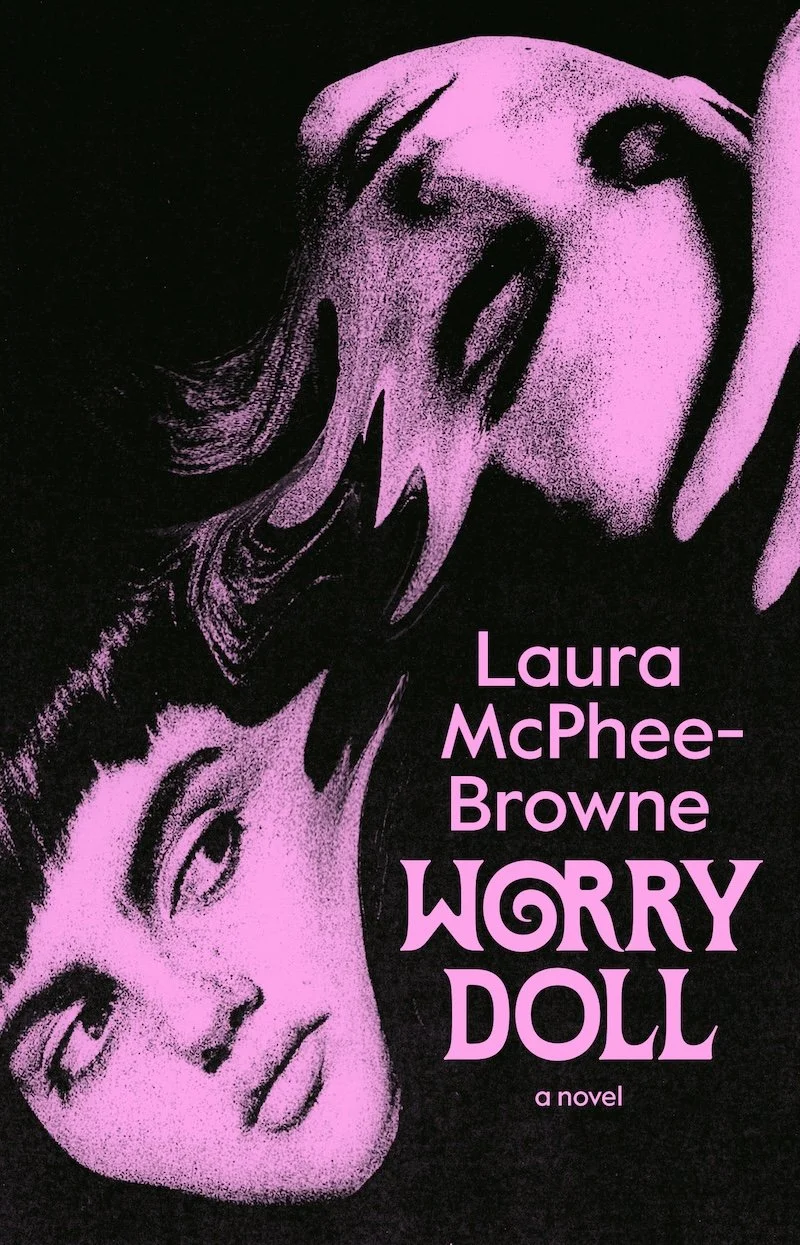
This story lives in the minds of Lacey and Heloise who meet on a Melbourne train and connect instantly. Following the aftermath of their meeting, we see how they each rationalise their subsequent actions and feelings, through different perspectives, to utterly divergent ends. Is it an affair, a fling, a relationship or nothing at all? Neither have control over the narrative’s truth. From the author of Cherry Beach (2020) and Little Plum (2023), Laura McPhee-Browne’s recent release Worry Doll (2026), published by Scribe, is a psychological page turner with tendrils that drag the reader in, at times begging for an objective eye.
Set among Narrm’s bustling restaurants and clammy tramlines, the first half of the novel is spent with thirty-six-year-old Heloise. She is in a long-term relationship with Ernie, whose sense of contentment contrasts with her dissatisfaction. Walking with Heloise through a week of social events and her work at a refuge for women fleeing violence, the reader is party to her stormy mind. We know that what she says differs vastly to the way she thinks. Eighteen months after Heloise’s week ends, along with her affair, we meet twenty-four-year-old Lacey and her perspective takes over in the second half of the book. Lacey has retreated home to Aotearoa. Despite how powerful she seemed in Heloise’s mind, it’s clear she is isolated and lost.
Love, attraction, obsession and lust all converge on each other in this novel so that each becomes confused, sometimes unrecognisable, in isolation. Heloise falls “hopelessly in love” with Lacey quickly, perhaps too quickly. But she defends the integrity of this love, using it to justify the ethical challenges that come with infidelity. “Love doesn’t have to be earned over time… It can be quick, and it can flicker strong as if in a cathedral.” Heloise also diagnoses this love, wondering if she’s a sociopath or narcissist. This tendency, and her need for secrecy, suggests the affair plays another role for Heloise. She admits, “She knows a life lived only in the light couldn’t sustain her.” It’s a sentiment that resonates with the performative aspects of her life, and is captured in the epigraph, a quote from Beverley Farmer’s Alone: “I come alive at mirrors and at windows, in artificial life. Light, I mean, artificial light.”
While Heloise recalls the sweaty, messy and seriously satisfying sex that kicked off the affair, most of her story centres on the obsessiveness a new love interest catalyses, especially in each other’s absence. Waiting for a text becomes an anxiety-inducing state of distraction. Though Ernie doesn’t understand its triggers, Heloise’s spiralling prompts him to gently soothe her with a pet name, “Worry Doll”.Lacey, however, is used to being obsessed over. “People fall for Lacey, splat on the ground and sing for her. She lets them.” But ultimately, the story proves that obsessing about whether someone likes, loves or lusts after you is a universal Achilles heel.
Crumbs of affection are fuel for Heloise. There’s no doubt she finds Lacey physically attractive, but there’s something about the ricochet of seeing herself in someone else’s eyes, appealingly, that seems addictive. After Heloise cuts her hair, she “wants [Lacey] to see it now, wants her compliments in case they buffer her day.” By contrast, Lacey guards her feelings, justifying her casual treatment of others to herself: “She is not required to embrace or respond to women as if they are the weather.”
The weather metaphorically holds up a mirror to Heloise and Lacey’s emotional landscapes, reflecting their unpredictability. Narrm is suffocating and electric, Aotearoa blustery and unrelenting. It pulls at the seams of their performances. Lacey studies the weather and a peer comments, concerning a machine they’ve developed, “I can teach it that something is going to happen, but it will never understand how intense it’s going to be.” This is a strong reflection of both Lacey and Heloise’s unpredictable behaviour.
Towards the end of the book, perception, reality and memory are called into question. For Heloise, day-to-day material things start to disappear and she begins to unravel, becoming unsure of her reality and sanity. Lacey progressively feels more adrift as the fling catches up with her. She places what she calls “a Worry Doll” under her pillow at night for protection, a talisman of sorts. Both women look to their bodies as a lodestar when lost. Pains and sensations offer clues about their feelings and what is happening to them.
Brimming with clipped, perceptive writing, McPhee-Browne’s Worry Doll seamlessly translates convoluted emotions. Written in third person, the story is intimate, but the reader is kept slightly at arm’s length which avoids over-empathising. Instead, we are encouraged to wrestle with the questions, biases or judgements that arise, rather than passively accepting Lacey and Heloise’s feelings and thoughts as character traits.
As I finished reading the last words of Worry Doll, my mind conjured a classic Joan Didion quote. Often, it’s used to inspire storytelling, but it also has a darker manipulative connotation, “We tell ourselves stories in order to live.” A clever, mind-bending read, Worry Doll questions obsession, dismissal, love and completely shakes up objective reality. It shouts: there are two sides to every story.
Caitlin Leishman is a Naarm-based freelance design journalist, communications specialist, research translator. A multi-faceted storyteller, she studied media and communications at the University of Melbourne. Caitlin’s career spans arts, design, science fields and collaborative projects such as life stories. She has regularly contributed to leading publications including est Living, Interiors Au and Habitus Living magazine. Caitlin is a voracious reader who can’t help but take note at every page turned, revelling in the gift that is seeing the world through another’s lens. Whether interviewing or reading, it is through unravelling the insights of others and interrogating her own perspectives that she fuels her own characterful body of work.