Lovesick by Lillian Telford
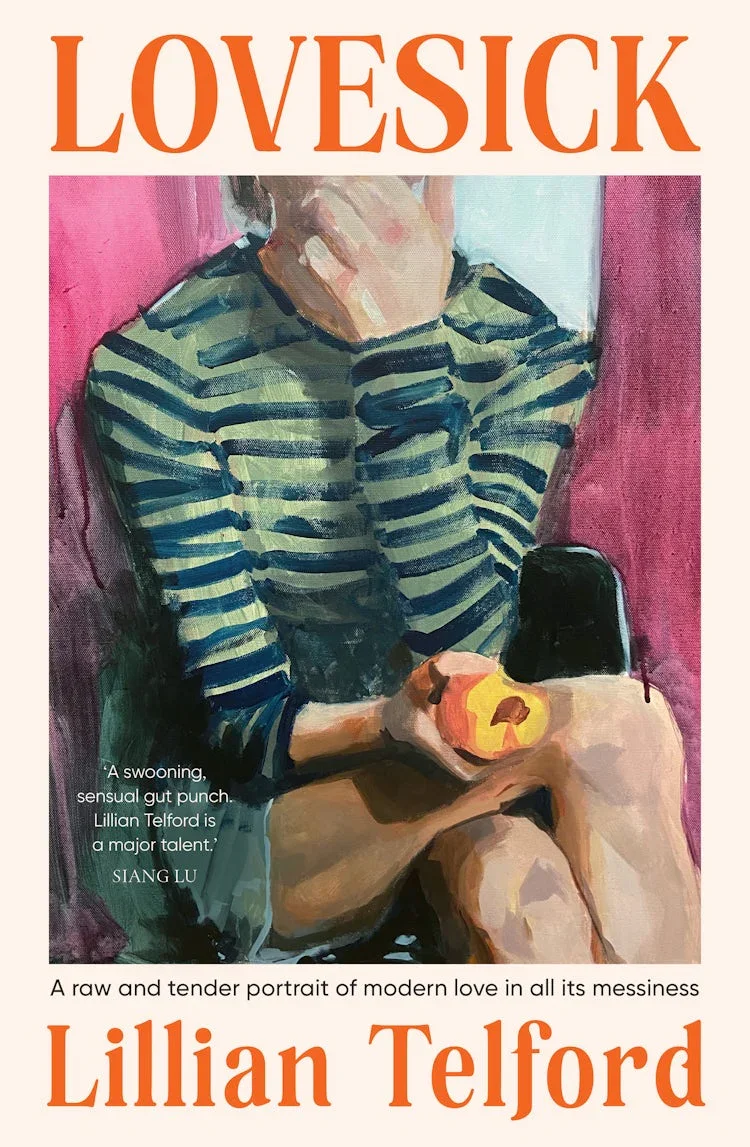
“Do you think much about love? About how abrupt it is?”
In Lillian Telford’s debut novel Lovesick (2026), Gabby and Gordon meet on a drug-fuelled night of partying in Brisbane. They’re taken with each other, but four pages into the book their year-long relationship is over. It’s a jolt between the sweet softness of their first encounter and the harsh glare of Gabby’s post-split spiral, and that back and forth gives an indicator about the way the novel will progress.
“It’s been days since Gordon broke up with me, days since I sent Ben that first text and he replied with: did you text me on purpose?”
The story emerges in a non-linear fashion, alternating between Gabby and Gordon’s point of view. Initially we see their relationship as it unfolds from Gordon’s perspective, and the aftermath of their breakup from Gabby’s. Telford changes tense – present tense for Gabby, past tense for Gordon – and that proves a wise choice, making what could have been a challenging narrative a little easier to follow. It also helps the reader understand how elements of the past are impacting the present. This out-of-sequence storytelling is not always done well, and Telford deserves praise for her deft handling of this approach.
“I settle on detective novels to hurl myself into, to keep me locked at home, flipping pages. It's only minutes after I sink into my sofa that the sobbing starts.”
It’s clear that Gabby is not managing the breakup well and this signal repeats through the rest of the story. Gabby’s projected confidence is a veneer; hiding underneath is a wounded little girl. She surrounds herself with people who seem equally damaged and it’s hard to tell whether it’s to make her feel better about herself or because she’s simply unable to connect with anyone in whom she can’t see slivers of her own reflection. The ways in which she attempts to numb herself through a false sense of connection (and punishes herself in the process) can be hard to read.
Alternately, we watch through Gordon’s eyes as he falls in love with Gabby. He too struggles with connection, but his reason for that is presented early in the story: his mother walked out on the family when he was a child, and hasn’t been heard from since. Meredith remains an unsaid word in his family, but also a ghost that hovers over their lives:
“Christmas was eggshells, and hauntings, and scarred memories. The house where he’d lived out his pale childhood, felt love and longing and the ever-present ache of something missing.”
Gordon worries that his mother’s abandonment has damaged him to the point where he's unable to form attachments without suffocating people. His father simmers with silent resentment and his sister Juliet doesn’t hide her anger; only his brother Adam seems to have found a healthy way forward. It’s this sense of abandonment that renders Gordon incredulous that someone like Gabby could love him back – and plays a significant role in their breakup.
This book is touted as a portrait of modern love, but it’s so much more than that. Yes, there’s love, but the relationships explored here go beyond the primary one between Gabby and Gordon. The theme of abandonment surfaces often. Gabby’s friend Róisín leaves to return to the UK; Gabby holds their friendship dear but it feels almost like an abusive relationship, and there are plenty of those in this book. Gordon hides his inner life, terrified of being left again and self-flagellating in his own mind. Gabby’s rebound with Chip is a tangle of use and abuse, while her ex Ben is the one who seems to see things clearly. It’s a realisation that comes to almost all the characters later rather than sooner. There’s trauma here, blended with jealousy and a sense of betrayal, but the reader still hopes Gabby and Gordon will find their way to some kind of peace.
“Most mornings he woke up incoherent, wondering why he was alone and remembering with fresh pain.”
When Gordon’s timeline finally catches up to Gabby’s, the reader is presented with his side of their split. It’s explained quite early that Gordon broke up with Gabby; as the reader follows his relationship with her through his eyes the question is again and again: why? He’s very much in love with her. When his reasoning is revealed, it’s quietly heartbreaking. The end of the story, though, is bathed in gentle hope, which feels fitting for these characters and all the growth they’ve undergone. It does a lot for Gabby and Gordon to be forced out of their own self-centred microcosms. When they’re confronted with memories of their childhoods that sit in contrast with their own, there’s a bloom of understanding and maturity.
Some parts of this book are not easy reading, and I found myself frustrated sometimes especially by Gabby. But Telford’s writing – her boldness of form and her exquisite prose – make it worth persevering. This is a real snapshot of modern Australian youth: the bonds we form, the messes we make and how we try to grow through them.
Amanda McLeod is a creative based in Canberra, Australia. She’s the author of two books, Animal Behaviour and Heartbreak Autopsy, and has had many pieces published both in print and online. Her recent works explore nature, ecology and connection, and some can be found in EcoTheo Review and Wild Roof Journal. A self-professed tree nerd, you can usually find her outside by the nearest river. If she’s not there, try Twitter and Instagram (both @AmandaMWrites) or her website AmandaMcLeodWrites.com.