Painting Portraits of Everyone I’ve Ever Dated by Joseph Earp
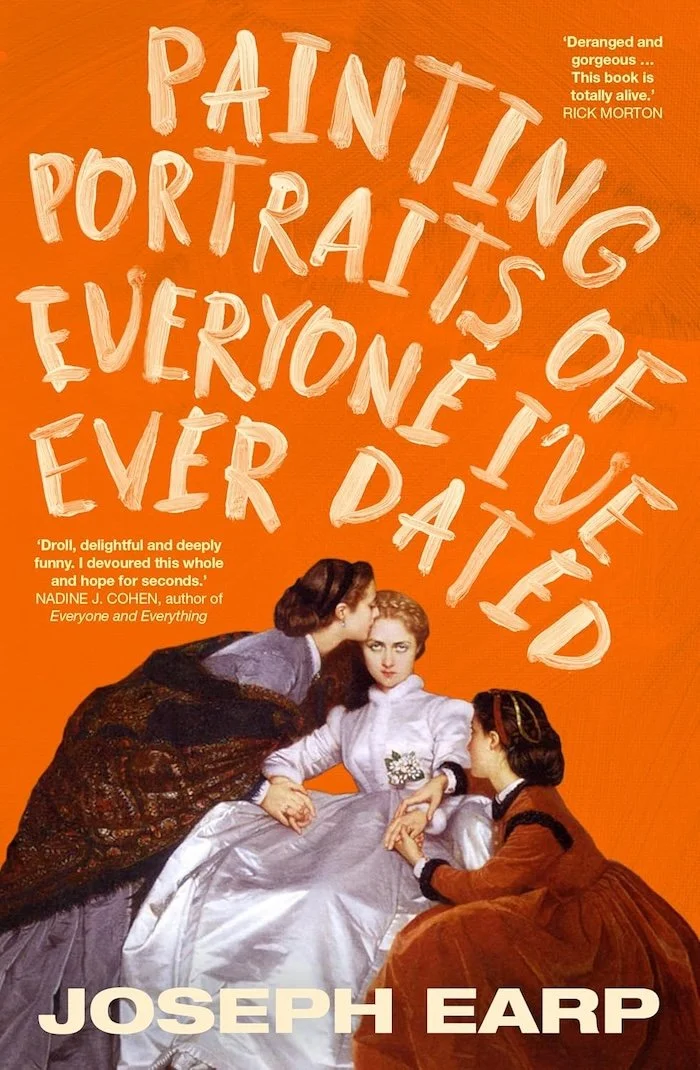
“It’s nice when the title is exactly-what-it-says-on-the-tin,” is how Joseph Earp describes his most recent novel Painting Portraits of Everyone I’ve Ever Dated (2025), in which the protagonist Ellie Robertson does pretty much that. Speaking alongside Zeynab Gamieldien and Lee Lai as one of the winners of the 2026 Sydney Morning Herald Best Young Australian Novelists at this year’s Sydney Writers’ Festival, Earp reflects on the matter-of-fact process of his fiction, the way writing explores hypothetical splinters of his own life and the representation of painting’s process and physicality. At the core of the novel is his desire to create something lighter, while retaining his emotional and introspective style.
And it opens with lots of humour. Upon winning a large prize for a series of paintings of sad gorillas, Ellie fumbles the ceremony and subsequent interview. As her deflective sarcasm and virulent perfectionism make her seem ungrateful and abrasive, a headline is written: “Ellie Robertson Hates Art”. The idea to paint portraits of her exes appears to her, clinical and emotionless, as simply her next task to complete:
“I don’t think I really know,” Ellie replied. “I don’t know why I want to do it.”
“Why don’t you paint something happy,” Dave said. “Like a flower or something.”
“Flowers are perverts,” Ellie said, matter-of-factly.
Yet she finds herself driven, as if the task itself might reveal the deepest flaw of her own psyche as well as a practical way to fix it, while also filling an exhibition and pleasing her no-nonsense agent Madeleine along the way.
This core conceit provides the forward momentum, but life continues to happen around Ellie. Friends and family disappear and reconnect. Milestones arrive and pass. The novel is structurally inconsistent – sections are divided based on the ex-partner Ellie is supposed to be painting, but within each section are scenes, vignettes and flashbacks that distract from the mission at hand. We experience the past and present lives of the painter and her subjects, and find that real life rarely fits neat structures. For Ellie, portraiture is a way of crystallising time and perspective, making sense of past observations of herself and her partners, and rationalising the people who sit before her as models in the present day.
To this end, there’s particular attention paid to the physicality of painting. Details like the drying times of oils and acrylics, or the fact Ellie never uses pure white for eyes, lend a tactile sensibility to the novel. Ellie’s skills of observation also draw our attention to faces, mannerisms, gestures and decorations. We interpret people through their appearances. In an early scene where Ellie is interviewed by an art critic, she notices a lightning bolt tattoo, the narrowness of his eyes and the way he pushes the microphone towards her with his shoe. She reflects:
“In order to be a good painter, you really had to look at things. That might be all it took. And there weren’t many opportunities for true looking in life – just art, and those first days of falling in love with someone, when everything felt fresh, and possible, and alive.”
Yet the novel fixates on the state of falling out of love – the explorations of past relationships, and the times Ellie hasn’t seen herself or her romantic partner clearly enough. The act of painting allows her to prolong and languish in these personal shortcomings. Artistic expression and romantic coupling, both culturally viewed as pursuits leading to fulfillment, are here presented as variously defective.
Earp is cognisant of Ellie’s status as a professional painter as a rarity within the artistic community. She contends with the external expectation that her life is special, that she is lucky and privileged to have the ability to paint full time. The financial realities of the creative life in the novel are recognisably Australian. Attendees of exhibitions are largely friends and family of winners and other hopefuls, with a scattering of critics, students and collectors. Those who engage and purchase pieces, funding Ellie’s vocation, are an upper class whose pecuniary access to the art world stems from something morally questionable. Among the well-wishers and the aspirants, Ellie is cursed with being the end goal of someone else’s dream, a vantage point from which she looks back with disdain at past work and forward with trepidation at any step she subsequently takes.
As such, the novel sidesteps the common criticism towards novels about artists, that the status of having “made it” makes their life unrelatable to the general reader. It’s a testament to the novel’s technique that between the awards shows and press cycles, Ellie is an ordinary person. She enjoys painting and does it often and well. She understands the theoretical side of things and can rattle off her inspirations, favouring Joe Brainard and David Hockney, but doesn’t speak from a position of distanced authority, but there’s also a sense that her greatest work is ahead of her, and she’s chasing something not yet completed. The steps into each artwork are uncertain, exploratory.
“In the rear-view mirror of the mind, all things flatten, the good and the bad. Ellie looked at Diana’s body, reminding herself, over and over, that this was someone she’d fucked, that she’d held, that she’d fought with …There was a reason they were here, in this space, listening to the gentle lull of traffic out the front, Diana’s body already coming out in the lightest patter of goosebumps. But it didn’t seem real.
‘Okay,’ Ellie said. ‘Let’s get started.’”
At times the tonal balancing between comedic exaggeration and serious introspection can be unwieldy, but the novel matures and lands its emotional payoff. The characters are recognisably the same people between the start and the end, and we come to see both their funny and serious dimensions. This is a character novel, and all of them – from our sardonic protagonist to her exes, her family and everyone in the art world – are compelling, believable and often beautiful.
But my favourite thing about Painting Portraits is that it feels so participatory. In addition to making me want to try painting, I felt invited to interpret Ellie, her character, her defence mechanisms and her choices, as if her self-portrait was on display. Within a novel written as a means to explore the author’s own personality is a narrator who paints to explore her own personality – and we find parts of ourselves reflected in both.
Harvey Liu is a writer from Sydney, Australia. He has completed a Masters of Creative Writing from the University of Sydney, focusing on short fiction. His work has been featured in publications such as Peril Magazine and Cicerone Journal. In 2021 he participated in The Writing Zone, a program guiding emerging writers run by the Writing and Society Research Centre at Western Sydney University. After 10 years of various jobs across high school teaching, copywriting, tech journalism and administration, Locative Magazine is his first venture into literary publishing. He is of Chinese background and speaks Mandarin with a strong north-eastern accent.