The Witch by Marie NDiaye, trans. by Jordan Stump
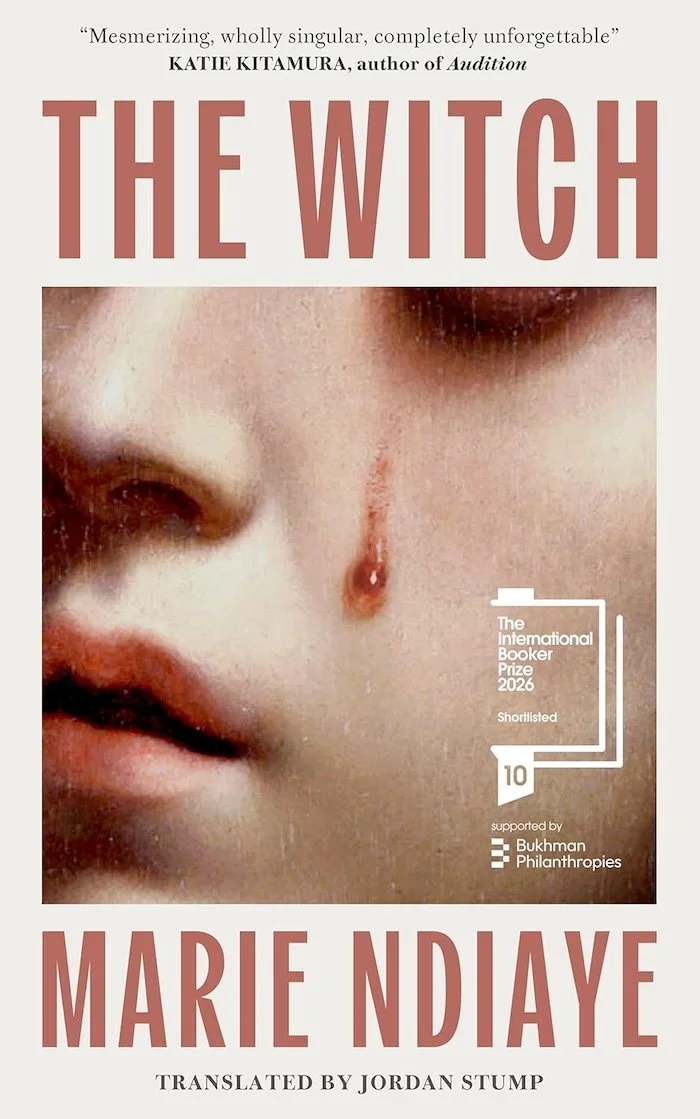
Tears of blood are rolling down the cheeks of Lucie’s twin daughters, Maud and Lise. From her basement in rural France, Lucie is determined to pass on her powers – mysterious magic that includes foresight. Yet Lucie is not the best witch; certainly nothing compared to her begrudgingly brilliant mother. As Lucie mulls over her daughters’ rapid improvement and changing attitudes to their magic, the family dynamics are divulged to the reader as Marie NDiaye transports the notion of the ‘witch’ out of fairy tales and into suburban family life – a setting inspired by the French author’s own surroundings while mothering young children. With the original edition released in French in 1996, this year’s English translation by Jordan Stump, published by Penguin Random House, has seen NDiaye’s novel recognised on The International Booker Prize 2026 shortlist.
As Lucie tries to ensure the legacy of her hereditary powers, her daughters laugh off her earnestness:
“I thought them so fierce, so resolute, so solidly asexual in the slightly grimy jeans hanging loose around their slim hips that once again I let matters drop, embarrassed to have let myself slip into sentimentality before that hard, gruff little pair.”
Maud and Lise are headstrong adolescents who don’t consider themselves vulnerable to Pierrot, their father, though their mother remains wary. Pierrot holds “disgust and contempt” for the powers beheld by the women in his life. Crisply told through Lucie’s pensive, anxious voice, the two-part story follows Lucie as she uses her powers in the mundane management of Pierrot’s moods, Lucie’s parents’ and in-laws’ needs, and the whims of their rich, gossipy neighbour Isabelle and her downtrodden son.
Tension builds throughout. Lucie seems resigned to their modest life, mostly concerned with protecting her daughters from tension generated by Pierrot, which she fears could become oppressive. A sulky salesman, Pierrot is enamoured by the riches of the Garden-Club he frequents, selling to a wealthy class he pretends to belong to. Each night, arriving home, his fantasy bursts. His delusional expectations layer the novel with another source of tension, atop his distaste for witchery. The witches’ power of foresight allows NDiaye to foreshadow glimpses of future events, contributing to tense anticipation.
Power is presented as both liberating and limiting. The powers possessed by the twins, stronger than Lucie’s own, invite choice and freedom. However, for Lucie, her weaker powers and the need to pass them on, alongside a maternal impulse to stay in an unhappy marriage for her daughters’ financial security, ultimately trap her. Her daughters’ stronger powers destabilise the mother-child dynamic, not only because the children hold more literal power, but also because Lucie begins to regard their growing strength not with pride but with reverence, almost as though they are choosing to evolve beyond her. She loves them but increasingly isn’t sure she knows them. When Maud and Lise sit judging people in a magazine, a tad dismissive and purposeless, Lucie regards them with awe.
“Looking at them, I finally understood what a real witch was, and I began to fear and envy Maud and Lise.”
Magic aside, Lucie’s story discusses the way life is happening to her rather than unfolding of her own will. Her personality is suffocated while family members continue to abandon her. The levers of emotional, financial and physical power are all pulled as NDiaye analyses her dilemmas and confused relationships within a petri dish of pressure. Lucie only slips out of subservience, calling on her power to negotiate for two ambitions – to pass on her magic and reunite her parents.
Surreal shifts could be misunderstood as a blasé and convenient way to move the plot along. However, in my mind, this is the power of NDiaye’s storytelling, holding lightness, wonderment and a sense of discombobulation alongside Lucie’s deep isolation. A hint of confusion sees the reader more easily empathise with Lucie’s own bewilderment and loneliness.
Despite this, The Witch is a funny book. Even the back cover copy wittily describes Lucie as a “mediocre” witch, as if any kind of supernatural ability could be mediocre. NDiaye also imposes ridicule on characters deserving of it, offering hints of reprieve for Lucie and the reader. When Monsieur Martin arrives home with Pierrot one evening to declare he’s left his family and unfulfilling life, Lucie calls Monsieur Martin’s wife. She arrives at Lucie’s front door with an apology and an exasperated eye-roll. This stunt has been pulled before, it seems. Pierrot’s admiration for Monsieur Martin comes crashing down. NDiaye gives Monsieur Martin a comically undignified exit:
“At the far end of the yard, Monsieur Martin was struggling over the hedge, his thin pale green springtime jacket billowing in the wind. He landed in the neighbours’ yard and galloped out of sight.”
Blurred around the edges with the fantastical questioning reality and interrupting everyday settings, this small, powerful book feels both light and compelling to read. It is propelled between humour and tension until a baked-in tenuousness surfaces, unsettlingly. Celebrating its thirtieth anniversary, NDiaye’s story, for me, resonated strongly. It challenges the presumption that loved ones will not abandon us, and something Lucie holds even more dear: the endurance of a mother-child bond.
Caitlin Leishman is a Naarm-based freelance design journalist, communications specialist, research translator. A multi-faceted storyteller, she studied media and communications at the University of Melbourne. Caitlin’s career spans arts, design, science fields and collaborative projects such as life stories. She has regularly contributed to leading publications including est Living, Interiors Au and Habitus Living magazine. Caitlin is a voracious reader who can’t help but take note at every page turned, revelling in the gift that is seeing the world through another’s lens. Whether interviewing or reading, it is through unravelling the insights of others and interrogating her own perspectives that she fuels her own characterful body of work.