Bird Deity by John Morrissey
Bird Deity is a provocatively non-specific title for a novel. It sounds like a phrase proposed or loosely translated by an anthropologist trying to describe some lately discovered society. It reminds me of The Golden Bough (Frazer, 1890), or, flicking through Lévi-Strauss, “Le Serpent au corps rempli de poissons” (1947). The underdetermined symbol permits the writerly “development” of an ancient theme, and the generic nouns create a decontextualised space where the anthropological becomes literary. It is ambiguous how literary; the effect – the kind of literature that we are dealing with – would be quite different if it were called, say, Falcon Goddess or Sparrow Master.
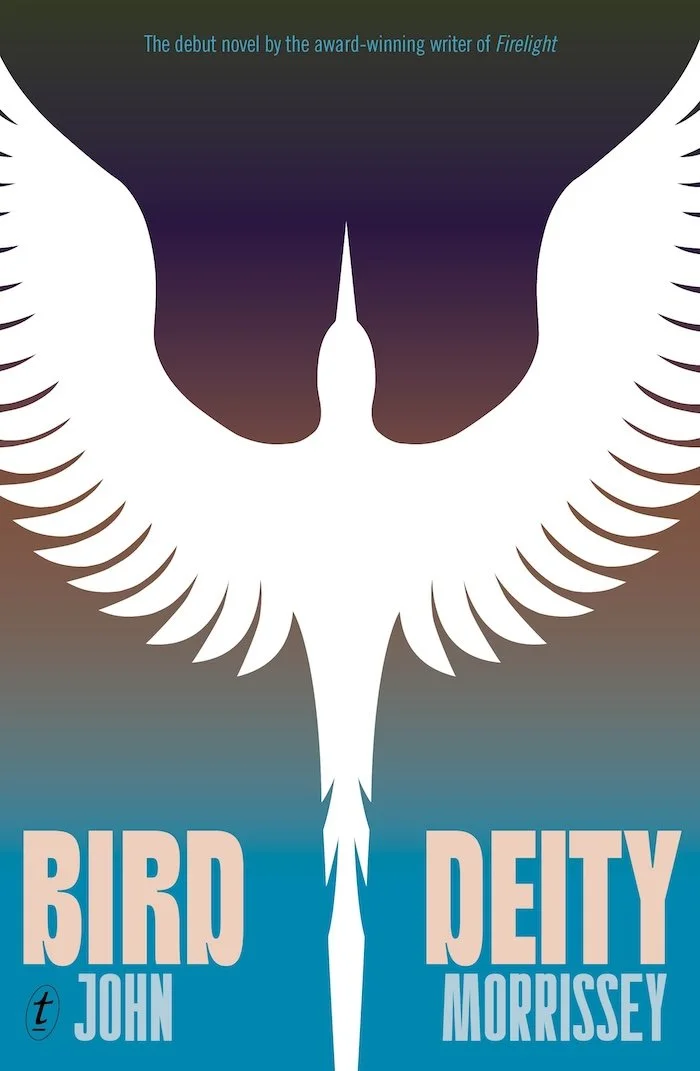
This problem of interpretation without context is partly what Bird Deity (2026) is about. It is the second work of speculative colony-allegorical prose fiction by John Morrissey, a prize-winning Melbourne writer of Kalkadoon descent, and its protagonist is a “scout,” David, who guides a – yes – anthropologist, Sarah, into the heart of the alien planet, which heretofore he has only exploited for the jewellery of its indigenous population. What they eventually find there is a great sculpture of a bird, ekphrastically described in a way that nicely matches the cover art of the paperback, in a possibly ancient and empty gathering place:
‘Look,’ she said, ‘an artistic representation. So far as I know, the first we’ve ever seen. And with a likely religious meaning, too.’
‘What meaning?’
‘It’s probably a creator spirit. That’s often the role that birds play in human narratives.’
This is a metatextual trope: characters in a work of art respond to a work of art. Here, Morrissey makes the trope anthropological. Sarah’s interpretive urge, and her professional responsibility, is to make meaning across cultural difference, as well as to impose categories, like “Bird Deity” and “artistic representation.” This is a gesture of empathy, but also of universalism. The Bird Deity is legible, familiar, a creature out of Jung or Joseph Campbell. Human bird, human deity.
The inhabitants of this alien world are called “parasapes,” which is, I think, a sci-fi contraction of para-sapian, an alternative sapience that parallels ape. Towards the end, a parasape narrator briefly takes over, ritually retelling the creation story of the Bird Deity to their Empress; “what a grotesque story,” the daughter of the Empress says. Sarah scores a point for correctly inferring that the Bird Deity is a figure in a creation myth. The scene of her interpreting indigenous art is repeated in this subplot-backstory of internal indigenous contestation of that art. This might be a critique of Sarah, whose anthropological inference is patronisingly simple compared to the complexity of parasape society. But, ironically, it might affirm Sarah: these parasapes do seem rather human. Asking this question provokes us as readers; our consumption of this novel becomes anthropological, and our interpretations become recognitions, comparisons.
Morrissey’s novel, like Kazuo Ishiguro’s The Buried Giant (2015), with its dulled, amnesiac characters wandering through the mist, has an affectively blunted, muted style. For example, it elaborates the underspecified quality of its title by including “native bushes”, “native spirits”, “pale native trees”, and “bitter tea, brewed from a native root”. Nativity is the primary or only modifier that matters, but it has become abstract, grey, like the planet’s constant rain, or the generic gestures of anthropology.
This despecifying and abstract style imitates the deadened life of the colony. But the other important character and ambiguous love interest, Eliza, is a botanist, and time spent with her is a glimpse into a potentially richer relationship to flora, curtailed by her separation from her partner and David. David himself finally gives up on returning to Earth, because the Bird Deity – it, or she – somehow speaks to him: “No matter what face the bird wore, this time he would welcome it with open arms,” is the last line of David’s story. Appropriation and radical acceptance are entwined, and the settlers go sincerely in search of character development.
Our third-person narrator is the primary, subdued voice of this grey new world. The parasape, by contrast, speaks in a courtly first-person: “One can feel the emptiness within each silver piece, yearning to be filled with the personality of the bearer”. This parasape technology, sought by the scouts, evokes fully-fledged social roles for psychically individuated speakers, as in a Charles Dickens novel full of contrasting voices and effervescent action – i.e. not John Morrissey’s novel. Bird Deity briefly glimpses court intrigue in a powerful empire, which would be quite a different story, a more familiar, variegated novel. Instead, this satisfaction is evaded and that story, or its vestigial ruins, is framed within another, equal parts violent extraction and empathic anthropology (the jewellery gives off a “pathic radiation” that corrupts human memory).
Bird Deity is, therefore, not a straightforward novelisation of the anthropological gaze or the settler-colonial narrative arc. This is partly because, as Mykaela Saunders says of Morrissey’s Firelight (2023), “although it seems like a parallel of our colonisation, it resists neat equivalence at the same time, freeing itself from a predetermined narrative fate” (in the Sydney Review of Books). In this case, Morrissey has made anthropology into a problem for the form of the novel, whose voices and plots scout, interpret and colonise each other. In order to be satisfied consumers and perceptive critics, we must also, it seems, read as little anthropologists.
George Cox has given up spreadsheets and is now a PhD candidate in English, at Johns Hopkins University, where he writes about twentieth-century novels and abnormal psychology.