Goodbye, My Love by Yumna Kassab
CW: references to domestic violence and coercive control
Most stories don’t start with goodbyes. But there are many that have goodbye written all throughout. This is the path Australian author Yumna Kassab has chosen for her protagonist Amina, who is married to Amin, and directly relays her disassociation, doubts and decisions about leaving the marriage.
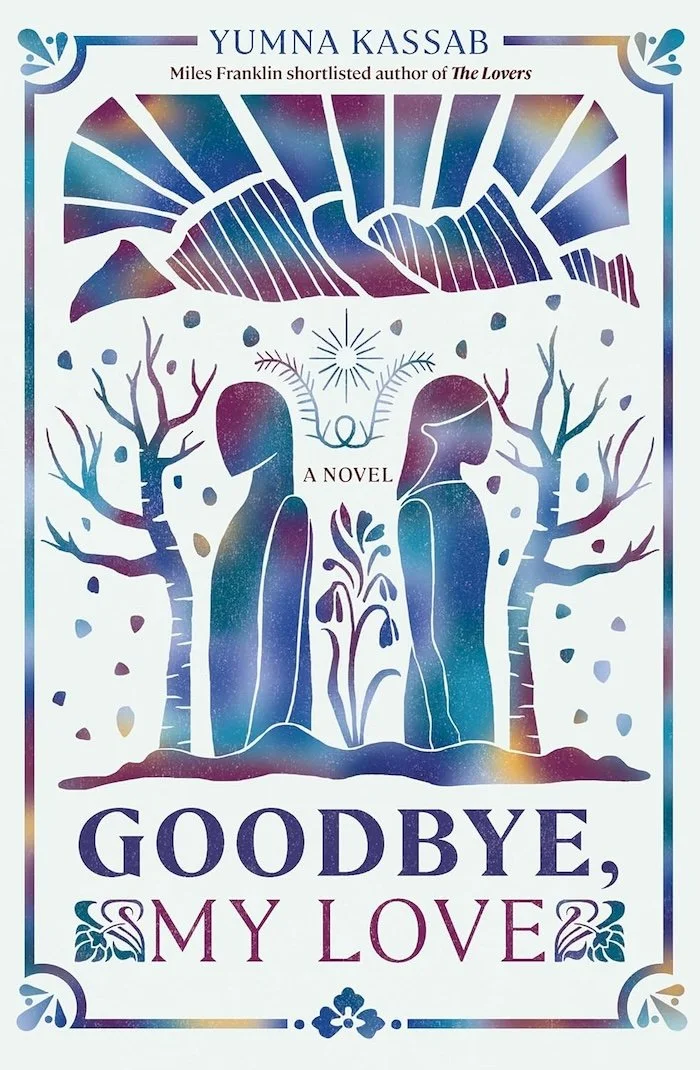
When I first saw the book cover, I recognised the style typical of Kassab’s book covers. What I didn’t know until I read her blog post, is that the front cover is illustrated by Mika Tabata, who also illustrated the cover of Kassab’s 2022 novel, The Lovers. This time, the lovers of Goodbye, My Love (2026) are positioned facing away from one another.
When we meet the couple we learn that these are not their real names – instead they exist for the purpose of the story. Or rather, Amin’s version of the story. Amin chooses Amina’s name for her. We also don’t know when and where the book is set, nor the detailed history which preceded the novel’s events. In that there is both freedom and constraint, but once the reader accepts the worldbuilding, the desire to question the minutiae becomes no longer relevant.
While not specific to any culture, we understand through the names and sayings that this centres an Arabic-speaking family. However, to me this is not an Arab story. It is universal, with the characters happening to be from an Arab background. It could have been set during a Covid-19 lockdown, fifty years ago or today.
I frequently find I am unable to compare Kassab’s writing to other writers. Her books can feel like a verse novel but not quite. They are slow, pulsing reads known for their polyphonic storytelling. Here, she also engages in multiple forms, recounting moments and exchanges with Amin and his small inner circle, vocalising Amina’s thoughts through monologues, stream-of-consciousness paragraphs, poems and biblical allusion to Lot’s wife.
It was refreshing to see a novel plotting the timeline of the breakdown of a relationship that isn’t about cheating and the associated, simplistic tropes. Instead, we bear witness to the painful deterioration of a relationship, one that you know is ending. This seeps into spaces beyond the home, such as the workplace:
“Her boss was angry and even though she wasn’t shouting, the expression on her face reminded her of Amin. Displeasure, disappointment, anger, shock that Amina had done what she’d done. And she wonders if for the rest of her life, any display of anger, no matter how muted, will remind her of Amin.”
As such, I cannot praise the chapter titled ‘Amins’ highly enough. I would type it all out if I could just for readers of this review to see why. Amina must contend with seeing Amin in every person and every moment. In fact, I found myself pondering the rhetorical questions Amina asks herself and trying to answer them. As she asks, “When did this revolution of Amins begin? She thinks it happened at puberty”, I thought about the all-too familiar socialisation of marriage as the definitive route where everything in your life suddenly clicks into place. This is especially true for women. Amina even at one point imagines her children – even though she does not have any – warning her:
“Maybe…. she is wasting her time here with someone like Amin, and the children are whispering, It is time for you to leave.”
As Amina learns the difficulty of wanting to be a “future-thinker”, she has to contend with the mark of Amin on her life. In this phase of Amina’s life, she is “free” but inevitably feels more trapped between the memories and having to start all over again. It is, as Kassab says, in the little details that rearrange one’s own world after morphing your life around someone else. It’s almost as if existing in a heterosexual marriage means existing as a muse to your own husband and when you do something that is not muse-like, you are punished.
The idea of choosing one’s partner meaning that you also chose whatever circumstance they leave you in is interrogated. As the prose becomes repetitive it is not because Kassab is trying to emphasise a point but because we are inside the mind of a woman navigating coercive control. The use of language like “walking on eggshells”, “punishment”, and patterns of silent treatment, are clues that should be obvious.
“Didn’t the research say intermittent punishment was worse, that a person ends up on eggshells because there’s no guessing when the punishment will be dished out?”
The body and mind learns to expect and the waiting for punishment becomes more destructive than the act itself. We are implicitly told that Amina has tried to find the answers and researched the symptoms.
We also see a brief glimpse of a life almost lived with Ahmed who has no future to offer and no dreams that he shared with her. She reminisces on the idea of laughter, central to Ahmed’s way of moving through the world. His words, “My laughter is about all I have in life, don’t you think?”, stay with her long after they move on from each other.
In domestic violence, a tradition of silence permeates. The reader can recognise when Amina is frustrated by Amin who is able to express disagreement and anger. She has a million ways to respond to Amin when he divulges their fight over a matchbox as if it were a funny anecdote to his family. Yet she doesn’t. We see Amin’s history of casual belittling and mockery expose his ridicule and laughter at his own wife. This thread about laughter is a cruel irony as Ahmed’s laughter and teasing is rooted in the opposite of cruelty.
If marriage is to be about who gets the last word, then it is no longer what it purports to be. It renders itself a redundant and never-ending competition where one way of life dominates the other. Domination is often achieved through sustained violence and coercion. It is only a matter of time before this system crumbles, in the hope that one day society is able to recognise abusive relationships before someone trapped in them has to explicitly name it out loud.
And yet a book about intimate partner violence does not need to be labelled as one for the reader to recognise the abusive pattern of behaviour. Even if there is no physical violence, years of coercive control can leave marks beyond compare. The narrator says it best: “When she left him – properly, for good, I mean it this time – she regretted leaving behind her choices.”
All throughout, Kassab offers us thoughts vocalised and slithers of what is withheld. Amin is labelled as the serpent in paradise, but was there really a paradise to begin with? Perhaps “the love” in Goodbye, My Love isn’t Amin. It’s for the life that our protagonist lost while becoming Amina. It’s for a person we, the reader, do not know and will not get to know.
Valerie Chidiac (she/her) is a writer and actor born in Beirut, Lebanon and raised on Gadigal land. She has written and/or edited for Honi Soit, WATTLE,Overland, Playdough Magazine, Apricus Literary, and Journals of Love and Literature. In 2024, ATAR Notes published her first book, a text guide for Jane Austen’s Emma (1815). Outside her day job, Valerie is currently a Junior Curator at the Young Australian Film Festival and volunteering at the Sydney Writers’ Festival.