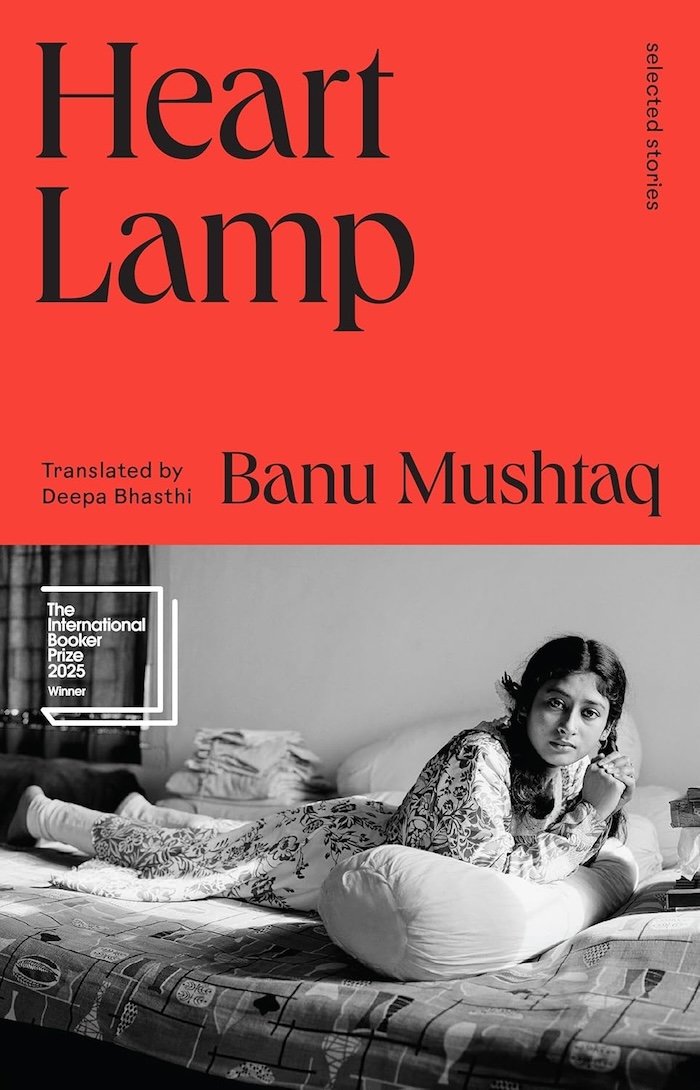
Heart Lamp by Banu Mushtaq, trans. by Deepa Bhasthi
“He recited the lines like a good student who had learned a poem by heart and was now repeating it with his eyes closed. His eyes remained on the floor. I did not answer him for a long time…Whether the naughtiness of his boyhood still remained housed in him or not. But no, he did not meet my eyes, and carefully escaped all evaluation. Some people are like this. They turn everything upside down.”
The twelve stories compiled in Heart Lamp by Banu Mushtaq (2025) span 33 years of the writer's life, detailing the lives of women, their families and Muslim communities in southern India. Originally published in Mushtaq’s native language, Kannada, they were translated into English for the first time by Deepa Bhasthi and won the International Booker Prize in 2025.
As a journalist and lawyer, Mushtaq tirelessly fought for women’s rights in India and pushed back against caste and religious oppression. In these stories, she brings together personal and fictional experiences to highlight the highs, lows, challenges and heartbreak of women in the communities she spent her life surrounded by. In ‘Stone Slabs for Shaista Mahal’, a woman listens to her friend's husband proclaim his unyielding love for his pregnant wife and the children she has already birthed him, only to marry a much younger second wife when she dies soon after the new baby is born. In ‘Red Lungi’, a wealthy woman decides to have her sons and nephews circumcised, inviting boys from local poorer families to participate in the right of passage. When her own son, seen by a doctor in a more prestigious medical clinic, suffers infection and illness following the procedure, she is shocked by how quickly an older local boy recovers.
“She grumbled to herself, ‘Khar ku Khuda ka yaar, gareeb ku parvardigaar’ – if there are people to help the rich, the poor have God.”
All of the stories highlight these forms of accepted inequality within the community, whether between men and women, rich and poor, with Mushtaq subtly but powerfully highlighting the ways the rules of engagement often shift, particularly between men and women, as they try to navigate family dynamics, religious duty and their own needs. While some stories are lighter and wittier, others dive more fiercely into more challenging territory. In ‘Black Cobras’, the tragic death of a young girl in the arms of her mother after she has sought help from the Mutawalli (a community individual responsible for managing and overseeing waqf, charitable endowments in Islamic law) causes a stir amongst the other women, who all begin to remind the Mutawalli that they too have their own kind of power.
“Jameela Athe scolded loudly, as if she was addressing someone: ‘Nothing good will come your way. You will be born with a pig face on Judgement Day. May black cobras coil themselves around you. May you not remember the Kalima on your tongue when you die.’ She tossed a string of curses around like dynamite.”
The titular story, ‘Heart Lamp’, is equally one of the more harrowing stories in the collection, even more so when you learn that it is based on Mushtaq’s own lived experience. A young mother, struggling to cope after her husband has seemingly left her for a young nurse, returns to her family home with her baby, only to be shunned and returned to her marital home lest she disgrace them all. Watching her brothers talk and laugh with her husband as though nothing had happened, only for her husband to leave her again once her brothers leave, she makes a terrible decision.
“The plants she had nurtured looked like they were weeping. They seemed to nod in agreement with the decision she had taken. She came back inside, locked the door behind her, went to the kitchen, picked up the can of kerosene and went around the house, unable to decide where she should be when she poured it on herself.”
Each story takes us deeper into the communities and their ways of life, teaching us something new with each experience; whether that lesson is good, bad or simply factual will depend on your reading lens. I will say that many of these stories continue to speak to me, weeks after reading, with another subtle teaching moment.
In her translator’s note, Bhasti shares the challenges of translating languages like Kannada, Urdu and Arabic into English, what’s lost or misplaced along the way. I found Bhasti’s adherence to Mustaq’s way of writing, which is often a mix of languages due to multi-lingualism, refreshing. She retains certain sentence structures and words, particularly those related to family structures and formal/informal titles. This approach forces the reader to think outside of Western linguistic constraints and fully immerse themselves in Mushtaq’s world, especially the more complex hierarchies of community and kinship, while always remembering that we are the outsiders looking in. These stories were never written for us, but for a society that Mushtaq saw as needing a wake-up call. These stories are her rallying cry, and they roar loudly.
Elaine Chennatt is a writer, educator and psychology student currently residing in nipaluna. She has a special interest in bibliotherapy (how we use literature to make sense of our lives) and is endlessly curious about the creative philosophies of others. She lives with her husband and two bossy dachshunds on the not-so-sunny side of the river (IYKYK). Find her online at wordswithelaine.com.