Mother Salad by Helena Pantsis
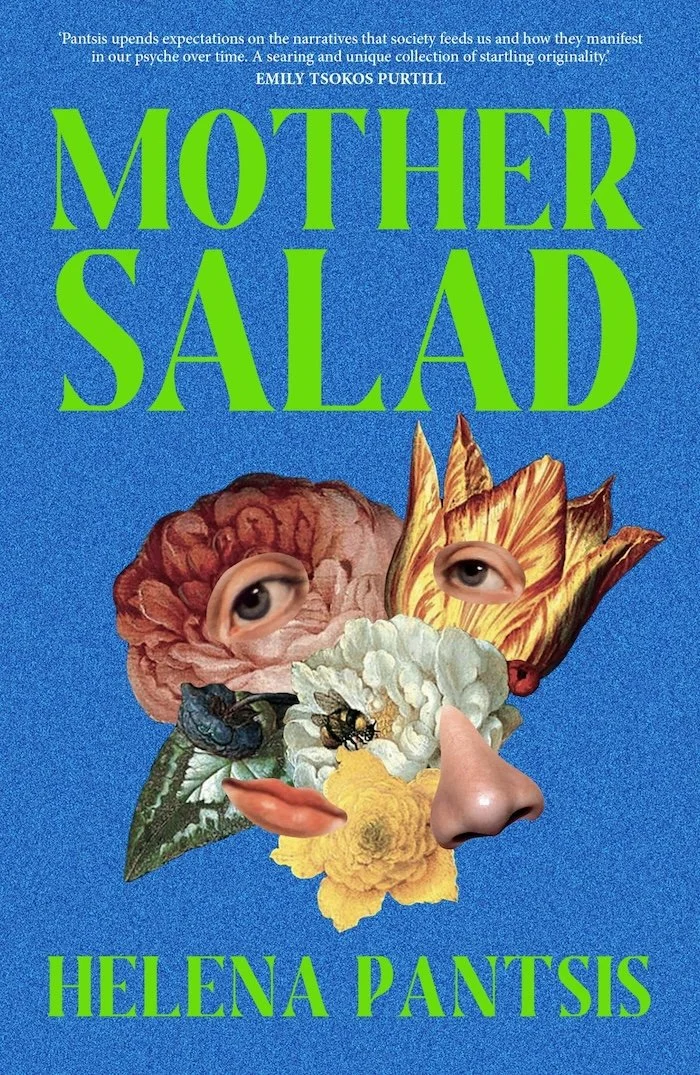
Victoria-based author Helena Pantsis’ second short story collection Mother Salad (2026) births a litter of 21 squealing stories, each of which pays homage to motherhood. Some directly investigate the mother-child relationship, with characters navigating the waves of both closeness and estrangement. Others play with the idea of being a mother – of nurturing, detaching, yearning. It is here where Pantsis’ stories are strongest, reminding us that the theme of motherhood can appear as a foundational narrative structure.
Many of the stories use a conceit to represent the unbreakable mother-child connection: a string in ‘Cottonmouth’, imprisonment in ‘Last Birthday, The’, an obsessive crush in ‘Girl Flesh’. Each allegory is intriguing in its own right, as well as in the way it probes deeper into the layers of motherhood.
While in several stories Pantsis portrays the indistinguishable closeness of the mother-and-child bond, in ‘The Death of a House Spider’ the protagonist Alma navigates parental estrangement. Alma can read her mother’s moods like a dog predicting a thunderstorm, finding clues within minute facial movements – “the hard vague stare; the lines in her face dropping away to nothing; the flared nostrils and the curled fists”. This unflinchingly familiar portrayal also begs the question – does fear imply closeness, even if in a different form?
In ‘All Animals are Deer in the Forest’, Pantsis comments on the unremovable expectation of womanhood and home-making. Ava shows her children an intricate tapestry, and they point out that a washerwoman looks similar to her. This sparks Ava’s obsession with this woman in the river, whose position on the tapestry often inexplicably changes, destabilising Ava’s mental state. After hours of handiwork refurbishing the embroidery, Ava is engulfed into it as a figure herself – a terrifying metaphor for the all-consuming, inescapable nature of a mother’s labour.
Of Ava’s physical labour, Pantsis writes:
“Her body was slowly crumbling under the demands of the task, back hunched and eyes squinted. Her hands had numbed so she could barely tell when she poked herself with the needle anymore, and so sometimes she would exit her daze to find thread binding her to the canvas in front of her.”
Pantsis also explores the role of the daughter as a foil to the mother. She positions this dynamic in various genres, framing this as so foundational it defies classification. In the apocalyptic zombie story ‘Someone’s Dead Daughter’, after the death of her parents,the narrator states, “What was left but me and my daughter to exist as their legacy”. It is this fact that partly motivates the narrator to deny her daughter’s zombification as a form of death – she craves her own continued motherhood to reconstitute her mother’s absence. Here, Pantsis reminds us of the infinite regress of motherhood, and how destabilising it is when this chain is broken by death or estrangement.
Many of her narratives inherit the space between closeness and estrangement. ‘Sea Monkeys Don’t Die’ takes the form of a phone call from daughter to mother, where the daughter frantically expresses her fears about her children’s ballooning sea-monkeys. The narrative voice perfectly simulates an overdue phone call with your mum – tangential (“I once heard something about lobsters being biologically immortal”), apologetic (“I should call more often…It’s just hard, you know, with the kids and all”) and frustrated (“Are you saying I’m harvesting organs in my fucking backyard?”).
Finishing the collection, my mind is filled with characters young and old, stubborn and soft. But my mind is also transformed: I see mothers everywhere: every story, structure, feeling. In the acknowledgements, Pantsis writes, “This collection is a testament to all the women, and the women-adjacent, and the mothers, and the mother-adjacent who have made me the person who I am today”. Indeed, she depicts motherhood more as character than as classification, an act best performed by fiction.
Ariana Haghighi is an emerging literary critic with proud origins in student journalism, editing student magazine PULP (2022-2023) and student newspaper Honi Soit (2024). In 2024, she chiefly organised the inaugural Student Journalism Conference. She has been published in Meanjin and Overland, and is happiest when reading or underwater.