Rebirth by Antoun Issa
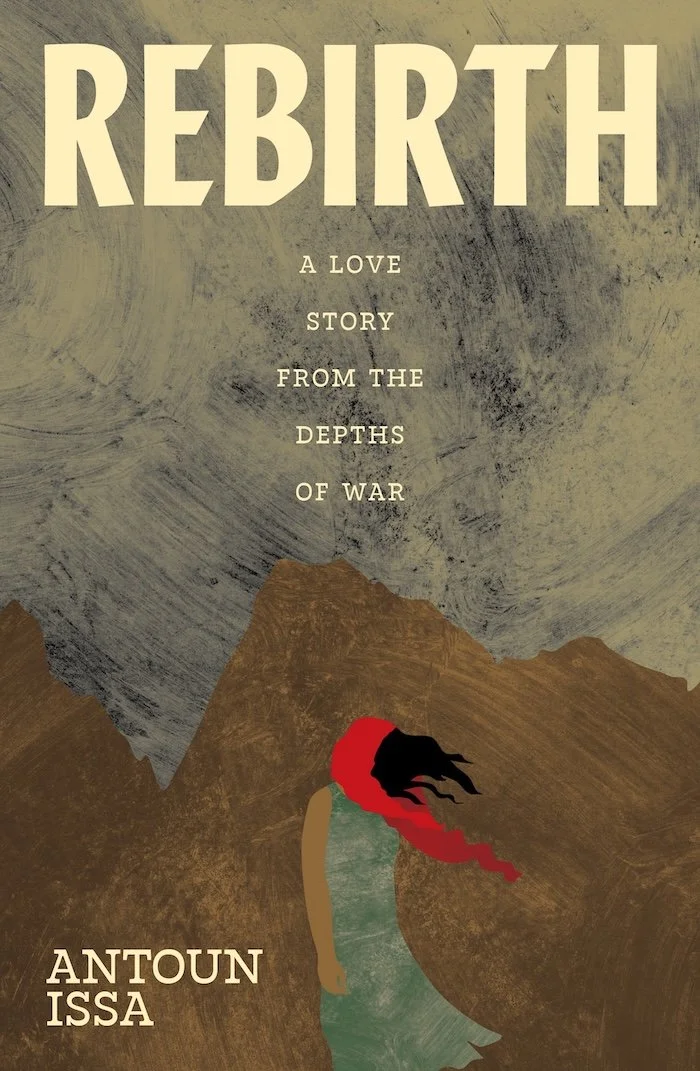
If you enjoyed Songs for the Dead and the Living (2023) by Sara M Saleh, Cactus Pear for My Beloved (2024) by Samah Sabawi, Don’t Ask the Trees for Their Names: Stories of Leaving and Becoming (2025) edited by Oula Ghannoum and Loubna Haikal, then Rebirth (2026) by Antoun Issa is for you. Issa draws on his own personal history, distills it into novel form and reiterates that the personal will always be the political.
Based on his mother’s experiences during the Lebanese Civil War (1975-1990) before migrating to Australia, the book takes the reader back to 1974. We’re in Jisr El-Basha in Beirut where Laila Khalil lives as the eldest of five children. She is taken out of school to work and support her parents, Fares and Nour, while also navigating her developing feelings for the local hairdresser, Nicolas, before war officially breaks out.
In the novel’s three-part structure, there are references to the Phoenician/Canaanite deities of Baal (fertility/weather), Mot (death) and Anat (maiden/warrior). Rebirth is about living and surviving the day-to-day, waiting for reprieve or an abrupt end to the war. Mjaddara (lentils with rice) becomes the go-to meal. You make do without medicine for days on end. You remain inside until the streets are ‘safer’. It is about sustaining life with as little as possible:
“If necessary staples remained accessible and they constrained their movements as best as possible, with Samir keeping contact with the forces that controlled the Jisr — perhaps waiting out the storm was possible… The families that left were those with the means to do so, and abodes and relatives in the mountains who could provide safe refuge.”
As someone with Lebanese heritage who did not grow up in Lebanon, the details of Beirut are intricately painted. I was able to recognise the geography and found myself discussing locations mentioned in the book with my mother. Outings like the 1975 Fairuz concert in Piccadilly Theatre reminded us powerfully that beautiful memories outlast the event itself. Having grown up with parents who recounted happy moments during the war – as much, if not more than the horrific ones – I was appreciative that this was a story set against the backdrop of the civil war and not endless trauma packaged as ‘educational’.
Whether or not diasporic fiction is a literary category, some fiction caters to a Westernised lens. Rebirth rejects this. Violence is not sensationalised but received as news or witnessed from a distance such as snipings, death by identity card (ذبح عالهوية) or young men being threatened to join militias.
When Laila marries her husband Mikhail, she vows to escape an existence in a deteriorating Lebanon. Laila adapting to her new environment could have been its own book but the chapters on living in Australia are deliberately abrupt. Time passes quickly because that is what migration feels like. Nour, Laila’s mother asks, “Do you think your heart will ache less in a different country”, a question every migrant has mulled over time and time again.
Laila inevitably answers this question, noting the strange silence of Naarm/Melbourne versus Beirut, “whereas billowing laughs and cries would ring out in the Jisr, only hushed sounds could be heard around their house. Hollow was her neatly paved street, devoid of clamour. Within their red- and yellow-bricked fortresses, nameless faces slept and crept.” This comparison is striking in its audiovisual descriptors as it shows a pensive Laila yearning for a life not lived rather than give a definitive answer.
Issa memorably addresses the reader in the prologue and epilogue, bookending the novel with Laila’s life in 2025. He states that without the events we just experienced, he would not have been born. We get to meet Laila, his mother just as we meet the young Laila in the pages of Rebirth, as he documents her life’s journey.
I couldn’t help but think about Lebanese-American poet Etel Adnan’s writing. I revisited her work, finding parallel sentiments in Issa’s. In particular, Adnan’s poem, ‘Baalbeck’, in her poetry collection, Time (2019) and excerpts from her prose poetry Shifting the Silence (2020) were resonant. They both write about formative loss at a young age, exile and lost love as intertwined as well as the “voyage of no return”.
“And having more memories than yearnings, searching in unnameable spaces, Sicily’s orchards or Lebanon’s thinning waters, I reach a land between borders, unclaimed, and stand there, as if I were alone, but the rhythm is missing.”
~ Etel Adnan, Shifting the Silence (2020)
“Our homeland, as broken and hard as it is, has a pulse you will never find here. Here, in this land, our stomachs are fed while our hearts go hungry.”
~ Antoun Issa, Rebirth (2026)
This natural kinship between the two writers across continents proves yet again why the written word is a powerful connective tissue in loving and writing Lebanon.
The depth of research gone into the national history to complement his mother’s personal history is very commendable. War did not result from religious differences but the politicisation of religion. Who is the majority versus minority became the order of the day, and arguably still is. We hear Laila’s inner monologue with an informed and confident clarity to describe the different factions and their positionalities, even as she experiences the war. She highlights that “both sides propagated a fear of annihilation at the hands of the other…They had conceived of imaginary threats, which had then spawned the real threats that had rendered her family prisoners in their own home.”
I am interested to see if Issa, also a journalist, continues to write novels, or historical fiction. In recounting his mother’s life in Lebanon and from historical events, Issa reconstructs a vision of the country that is close to the lives marked by the civil war, whether first-hand or second-hand.
As I write this review, I witness a Lebanon under rubble due to relentless Israeli invasion, bombardment and massacres. A country, existing somewhere between a weak and failed state, and propped up by a corrupt political class covering for one another. Pre-Taif Agreement tensions remain (the agreement which supposedly ended the Civil War), in addition to disjointed domestic and foreign policy, external state and non-state input, and unresolved economic and institutional crises. It feels as if Lebanon is continuously on its last breath. In Rebirth, I see similarities to the present. There will be no accountability for what transpired then, nor what is transpiring now.
Rebirth is about coming to terms with loss. It is about becoming parentified at a young age; becoming a mother while you still are being mothered. As Nizar Qabbani personifies Beirut as a woman in his poem, ‘Beirut, The Mistress of the World (إلى بيروت الأنثى)’, Issa’s mother mirrors Lebanon’s suffering. Maybe what Lebanon needs is a mother. I know Issa believes so too.
Valerie Chidiac (she/her) is a writer and actor born in Beirut, Lebanon and raised on Gadigal land. She has written and/or edited for Honi Soit, WATTLE,Overland, Playdough Magazine, Apricus Literary, and Journals of Love and Literature. In 2024, ATAR Notes published her first book, a text guide for Jane Austen’s Emma (1815). Outside her day job, Valerie is currently a Junior Curator at the Young Australian Film Festival and volunteering at the Sydney Writers’ Festival.