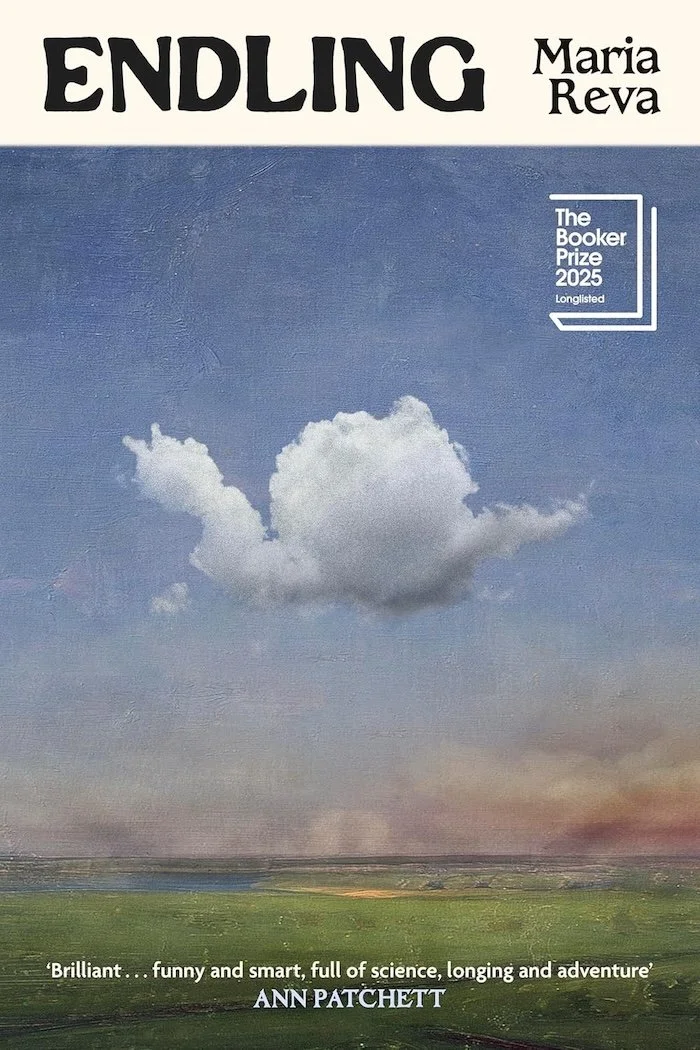
Endling by Maria Reva
“Yeva remembered the first time she’d had to record an extinction time stamp. It wasn’t always easy to tell if snails were dead; they’d often seal themselves in their shells with mucus as though for hibernation, then shrink away inside, leaving the world quietly. The weightless shells, exit still barred, taunted her like a disappearing act.”
Endling (2025) by Maria Reva has to be one of the more unique novels I’ve read in recent years. A meta-fictional novel within a novel (within a novel?), it starts with Yeva, a conservationist on a mission to save species of snails on the brink of extinction in her custom-fit-out mobile lab (a trailer) across Ukraine.
‘Endling’ refers to the last known individual of a species. Once it dies, the species is declared extinct, and this process of collecting the snails from destroyed or disappearing natural habitats consumes Yeva. But apart from Kevin, a fellow snail-saving enthusiast in Hawaii, there’s not much love (or grant funding) for the critters, and her efforts are beginning to feel futile:
“Snails weren’t pandas – those oversize bumbling toddlers that sucked up national conservation budgets – or any of the other charismatic megafauna, like orcas or gorillas. Snails weren’t huggy koala bears, which in reality were vicious and riddled with chlamydia. Nor were snails otters, which looked like plush toys made for mascots by aquariums, despite the fact that they lured dogs from beaches to drown and rape them.”
To support herself and her snails, Yeva works for ‘Romeo Meets Yulia’, a Canadian company that deals in "romance tours" to Ukraine (essentially, a mail-order bride business). It’s through this work that she meets sisters, Anastasia (Nastia), a supposedly eligible single woman like herself, and Solomiya (Sol), a translator for the agency.
But the sisters are harbouring a secret. Their mother, Iolanta, is the leader of a feminist activist group, Komod, which regularly fought against the exploitative mail-order bride industry. Except that the group has been waning for some time, and Iolanta disappeared from her daughters' lives some months earlier. Now, Nastia will do anything to get her attention and lure her home, including working in the very industry her mother loathed.
“How did the fight with her mother start? Had it been Nastia who’d snapped, baited Iolanta? What she remembered saying: how she’d always thought the topless protests were stupid, show for show’s sake. How gross it was that most of the sponsors were men abroad.”
When their mother continues to fail to materialise, Nastia decides to take a more drastic approach. One that involves Yeva’s trailer and the kidnapping of a dozen or so bachelors.
It’s up until this point that the novel follows a very conventional structure. The plot is enjoyable, the right side of predictable, with opportunity for more than a few humorous moments. Reva’s characters are fully realised, believable in their passions, griefs and struggles. If we were to follow them through the same early plight the novel introduces, we’d probably end up at a pretty robust conclusion. But Reva doesn’t offer this, at least not in any kind of straightforward way, as war breaks out between Russia and Ukraine, both in the book and in real life.
Reva, a Canadian citizen with Ukrainian heritage and family living in Kherson, seemingly ends Yeva and the sisters’ antics on page 136, complete with an author acknowledgement as the second section of the book veers into entirely new territory. I don’t want to give too much away here, because this is the part of the book that really gets interesting and forces the reader to sit with discomforting questions: What is it we seek from authors in times of crisis? How can one tell their story without it falling into ‘opportunism’? How can we fictionalise a war in real time (and should we)?
Reva pointedly shares personal experiences, emails between her and her agent, and editors, grant applications, creating a deepening of the connection between reader and author, a meta-fictional come-hither, as she breaks down what is and isn’t ‘acceptable’ for her to write about and in what way or context as a ‘voice of Ukraine’ in a time of war.
“Fourteen dead, ninety-seven wounded. But don’t let us interrupt. By all means, sink into those high-thread-count sheets. Tell us, Ms Voice of Ukraine, how do you toast in Ukrainian again?”
The third part of the novel brings us back to Yeva and the sisters' capers, but the spell is broken. We know what we’re reading and how Reva feels about it. She shares how a piece of her writing about Ukraine at war was rejected by an editor because of its dark humour, even though, she says, dark humour is how Ukrainians cope. And it’s this dark humour that creeps into the last section of the novel. The antics become almost slapstick, with the bachelors plotting to escape the trailer and the lengths to which each side will go to create a media vision of war that is entirely removed from reality.
And now that Reva has pulled the reader in close, she weaves in more of her own thoughts, feelings and worries into the narrative, taking on the persona of the Canadian-based owner of ‘Romeo Meets Yulia’, and weaving into the narrative a subplot mission that sends our heroines to rescue her grandfather in Kherson (but not before they’ve bombastically rescued another snail).
Endling is without a doubt the most inventive novel I’ve read in recent years, with a lot to say at its heart. I honestly could have happily spent the entire novel with Yeva and her snails, but as one reviewer points out, the snails are themselves a proxy for Ukraine: they might not be universally loved, but they deserve survival, and that requires more than one good-hearted biologist with a trailer to achieve.
Elaine Chennatt is a writer, educator and psychology student currently residing in nipaluna. She has a special interest in bibliotherapy (how we use literature to make sense of our lives) and is endlessly curious about the creative philosophies of others. She lives with her husband and two bossy dachshunds on the not-so-sunny side of the river (IYKYK). Find her online at wordswithelaine.com.