Chinese Parents Don’t Say I Love You by Candice Chung
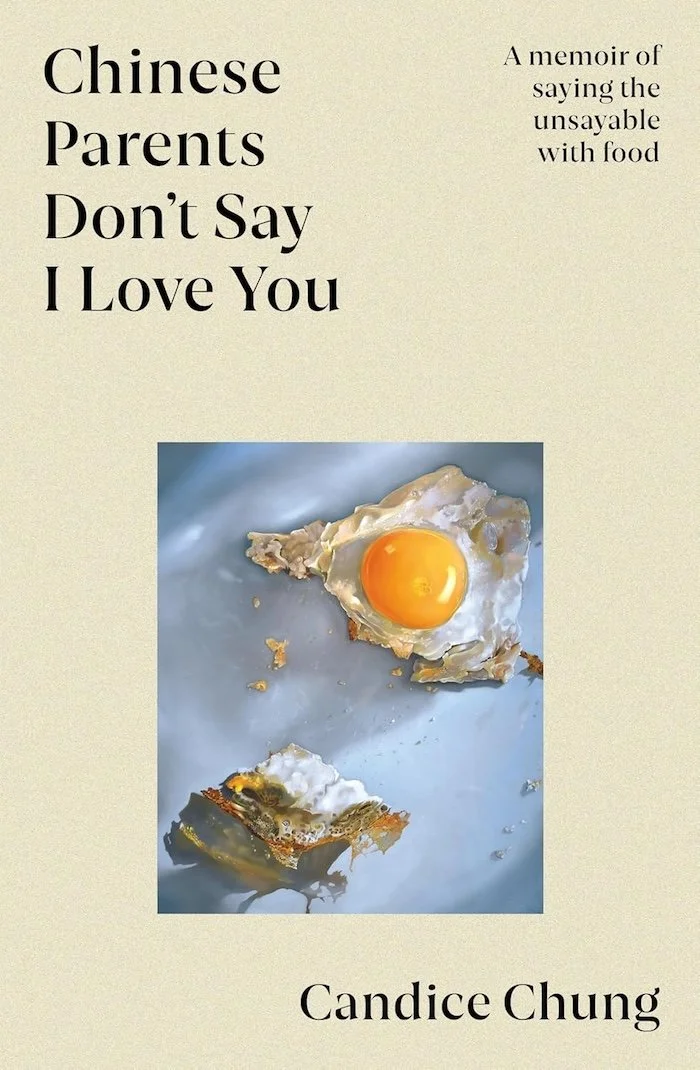
Former food journalist Candice Chung has written an appetising memoir in Chinese Parents Don’t Say I Love You (2025, Allen & Unwin)that is loaded with insights about romantic love, familial relationships and unhappiness, shaped around how food and the act of eating functions as a mediating space for dialogue and emotion.
Divided into three thematic sections Chung names and frames around the ‘Etiquette’ of eating – alone, as lovers and as a family – at the book’s core is her unfolding romance with, and subsequent marriage to, the character she calls the Geographer, which takes place over a two-year period from December 2019 to December 2021. Interweaving assorted moments from the author’s personal and family histories, chapters sometimes reflect more traditional narrative prose while others read like elliptical memories, fleeting and unformed, as with ‘Favouritism’ and ‘Back of House’ – composed of a mere four and five lines, respectively. A similar temporal instability emerges when the narrative flirts with bigger philosophical questions, as Chung invokes theorists such as Roland Barthes, Arlie Russell Hochschild or Gaston Bachelard. As with dressing or glaze, these musings on life’s bigger questions – like heartbreak, waiting as devotion, or emotional work reflecting observable labour – do more than simply add ornament, but instead bring a deeper layer to the work, albeit one still ripe for greater excavation.
We see heartbreak in fragments such as separating from a thirteen-year relationship with her previous partner, who Chung names the “psychic reader”, and the severity of her mental health in the summer that followed – disclosed only in the clinical language of a GP’s questionnaire, producing a score “distinction-equivalent in the areas of depression, anxiety and stress.” But Chung is not always so guarded – one chapter reinvents itself as a Choose Your Own Adventure, letting the reader guide a younger Chung through a parental anniversary buffet with all the warmth and absurdity that implies. The contrast is the point. Traveling from elliptical confession to outright wit makes the understated moments seem deliberate rather than incomplete, resulting in a desire for more.
Retellings of her family life, such as Chung and her sister as young girls mastering dishes made from tinned spam in the years following the family’s arrival from Hong Kong, arrive in big bold strokes, full of wit and pathos for the immigrant experience and Chinese culture. Beautiful moments of prose abound, surrounded by wonderful observations of the everyday. In one instance, streets are described as “slick with buttery rain.” And during an Italian dinner date with the geographer, as a large group of “bikies zoom past, all of them dressed in Santa Claus outfits… Everyone bearded in good cheer,” she notices “the similarities between the bikie and the Santa Claus physiques.”
This same quiet elegance of phrase tackles Chung’s interactions with her parents. An ache, a sense of longing to love and be loved, shapes the book’s narrative. Although also applied to romantic entanglements, it is when discussing her mother and father that we feel this most acutely. Her parents’ expressions of love come through gestures, such as holding each other’s hands in public for “nearly four decades.” But rather than using words to communicate inner feelings, as the title signposts, the provision of food, as with so many parents of a certain generation or culture, is the terrain where the practical stands in for the emotional. Hence, this single line can be said to reflect the book’s heart and soul: “A meal is a shape. It is a container into which we pour our cravings.” This unfolds in several ways throughout the narrative such as when Chung’s parents become her dinner review guests in the aftermath of the break-up, or in the quiet reflections on singledom that follow, or as the romance with the geographer slowly takes shape.
Chinese Parents Don’t Say I Love You is a somewhat elusive memoir, with only glimpses offered of the decade-long fracture with her parents and the quiet unraveling of her mental health. Chung holds these at a deliberate distance, offering fragments rather than bold confessional. But surrounding these major life events are wonderful stories about her personal history, prose abundant with wit and glorious observation. This is, ultimately, a book about what love looks like when it struggles to say its own name, and, like the best meals, is both nourishing and impossible to forget.
pine breaks (uncapitalised)
Identifies as a Black man, non-dualist, meditator, Afro-Caribbean, east-Londoner, ruralist, bread-baker, grower of vegetables, pro-alternative economies, musical snob, bare-footist, sometimes media academic, freelance writer and author of race and social-class based fiction.
He is most content when identifying as a being from the Universe.
Reach him at pinebreaks.com and X=@pinebreaks_me