Bathypelagia by Debbie Lim
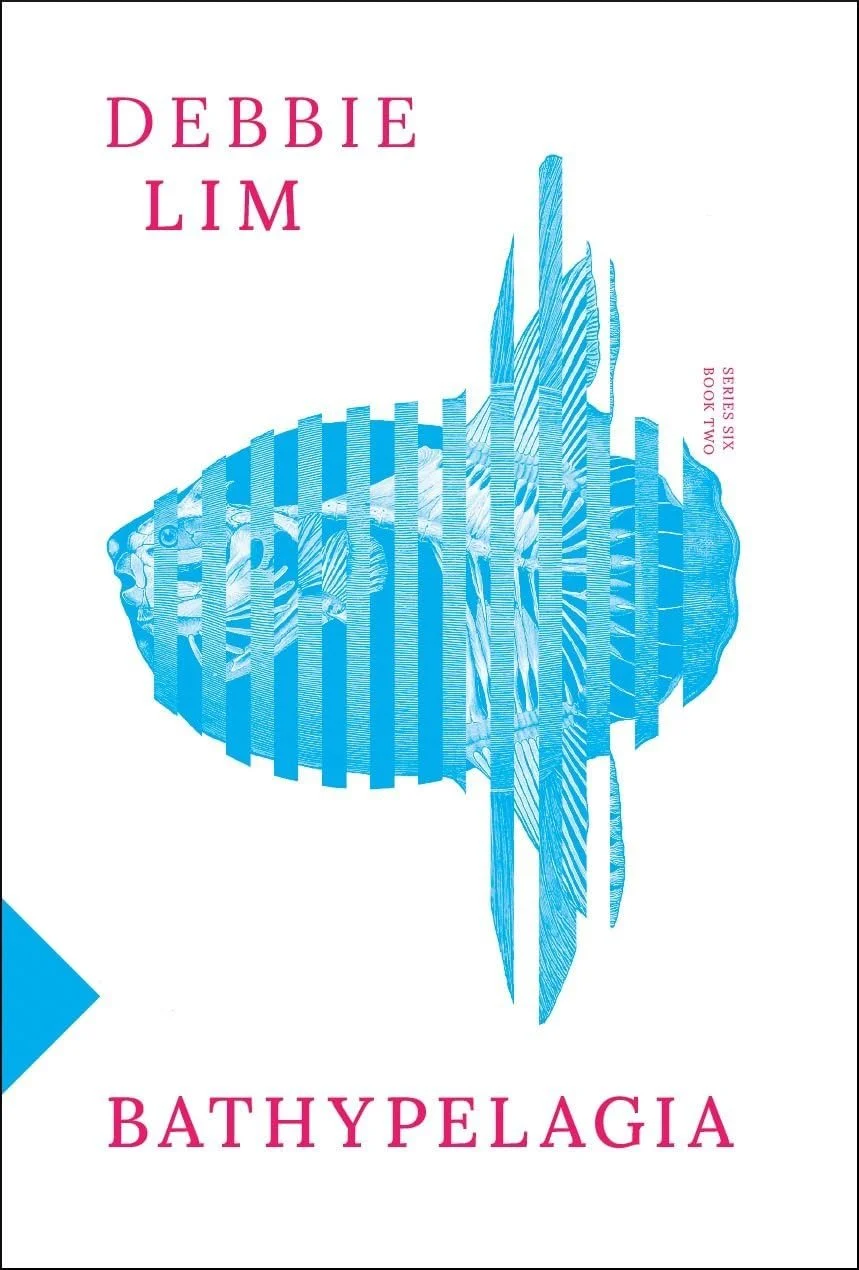
Debbie Lim's debut poetry collection Bathypelagia (2025) is named for the bathypelagic zone: the midnight zone, 1,000 to 4,000 metres below sea level, where no sunlight penetrates. The creatures that live there have learned to make their own light. Therein lies the book's most profound instruction to the reader: that descent doesn't necessarily mean darkness.
Everything in Bathypelagia moves either up or down. Firstly, the collection descends into the midnight zone and finds there not the alien but the intimate: the domestic, the nocturnal and the maternal. The 3 a.m. wakefulness of a parent. The lover who becomes predator. The child who becomes cephalopod. Lim's oceanic creatures – vampire squid, glass sponges, the sunfish that appears first taxidermied as "a papered gong" and later as "a field of floating moons" – are not simply observed from the outside. They are inhabited from within, which is to say they are already human by the time the poem reaches them.
Then the book ascends. Into air, into myth, into the raptor riding thermals "patient as a god". The condor's vision makes distance an illusion, the way depth does. The honey fungus speaks with "witchy bootlaces" of mycelial cord. The trees are instructed to "travel your roots boldly/ through darkness and to great depths – / they are your immense secret." Root and raptor. Midnight zone and thermal. The collection's argument, if it has one, is that depth and height are the same movement seen from different ends of the body.
The book has been well decorated, including being shortlisted for the 2026 NSW Literary Awards, the Kenneth Slessor Prize for Poetry and the 2025 Five Islands Poetry Prize. The Slessor judges called it “ostranenie” – making the ordinary strange and the strange familiar – which is accurate but perhaps insufficient. The defamiliarisation isn't lateral, isn't a shift of perspective. It's gravitational. Lim's poems change pressure. The reader descends into the domestic and finds it crushing and luminous at once, then surfaces into air and finds the same quality waiting there.
‘Love Below 2000 Metres’ announces the governing paradox from its opening line: "It is difficult to speak of love at these depths." What follows is not, immediately, a love poem the reader recognises as such. The creature speaking is never named. The poem proceeds by misdirection: there is a bower made of darkness, a light described as "worm of deception, burning weed, false ship of safety," a lantern watched through blackened trees that draws something closer through the illusion of collapsed distance. Only at the poem's consummation – the sudden gape of water at an accidental touch, the mouth's lonely trap closing – does the creature identify itself, and even then only by anatomy and act.
This is the anglerfish: the female whose bioluminescent lure dangles in the midnight zone to attract prey; whose mate, once found, fuses parasitically into her body, their bloodstreams joined permanently. "The cold slow fusing of our bloodstreams" closes the poem – a biological fact rendered as the most intimate possible union, which is also an erasure of self. The poem's achievement is to have made this feel like love. Yet Lim never uses the word anglerfish. The poem works by inhabitation rather than identification – we are inside the creature before we understand what creature we inhabit. This is the technique the entire collection practices. The ecological is always already autobiographical.
The domestic poems descend to the same midnight zone by different means. ‘Night Feed’, with a dedicated to Elijah, describes a nursing infant with biological precision – the flushed ear "laid down like new coral" – before the sounds of swallowing migrates registers entirely: it becomes "some bird's passing / call on its nightly migration." In a single clause the poem crosses the book's entire vertical axis, from underwater to aerial, in the space of a breath. The poem ends with its own form dissolving, the lines becoming "a broken web / hung out in a storm." The poem about an infant cannot hold still. It must move with what it tries to contain.
‘My son the cephalopod’ offers the collection's most comic domestic register. The child – catapulting soft arms, coiling around legs, propelling himself toward salty snacks – is identified from the title as his species. The poem's emotional weight arrives in parentheses: "(He doesn't know I save tiny sachets / of desiccant to night-dry my tears.)" Brackets perform the same function as depth: something held under pressure. The poem closes on the book's most quietly devastating domestic measurement – the mother attempting to rock the child with "the approximate weight / of an ocean."
The ascending poems answer the deep-sea poems by a different kind of erasure. The egret achieves its white hue not through absence but through process – days of sifting mud and stormwater – until she becomes "a snip of paper, / a perfect template, all colour chanted out." Where the anglerfish invents light to attract, the egret chants colour away until nothing remains. The poem closes by imagining egrets as lanterns set loose into darkness – lit souls, burning all night – then: By morning there is nothing to confess.
‘Anemone’, the final poem, positions itself at the threshold – neither in the midnight zone nor in the air, but at the surface membrane, buffeted by perpetual motion. Its closing instruction separates two acts by syntax alone: "We've all been / fettered and must learn: this grasping. / That letting go." Bathypelagia is a record of what lives in the movement between them.
J.M.C. Kane is the author of the non-fiction book Quiet Brilliance: What Employers Miss About Neurodivergent Talent and How to See It (CollectiveInk UK). His prose work has been published in more than three dozen literary journals & magazines, including Plough, Camas, AMERICA Magazine, Commonweal, Smokelong Quarterly, and The New Ohio Review, where his essay, “Nomenclature of a Life”, cataloguing his experience as an ASD-1, was awarded the 2026 Ellis Prize for Non-Fiction. Kane received the Honorable Mention in the 2026 Alex Albright Creative Nonfiction Prize and his recent poem “Sediment” was the runner-up in the 2025 GulfCoast Journal Poetry Prize. He lives in New Orleans with his family where he works as an environmental attorney.