She Who Tastes, Knows: A memoir of food, exile and awakening by Durkhanai Ayubi
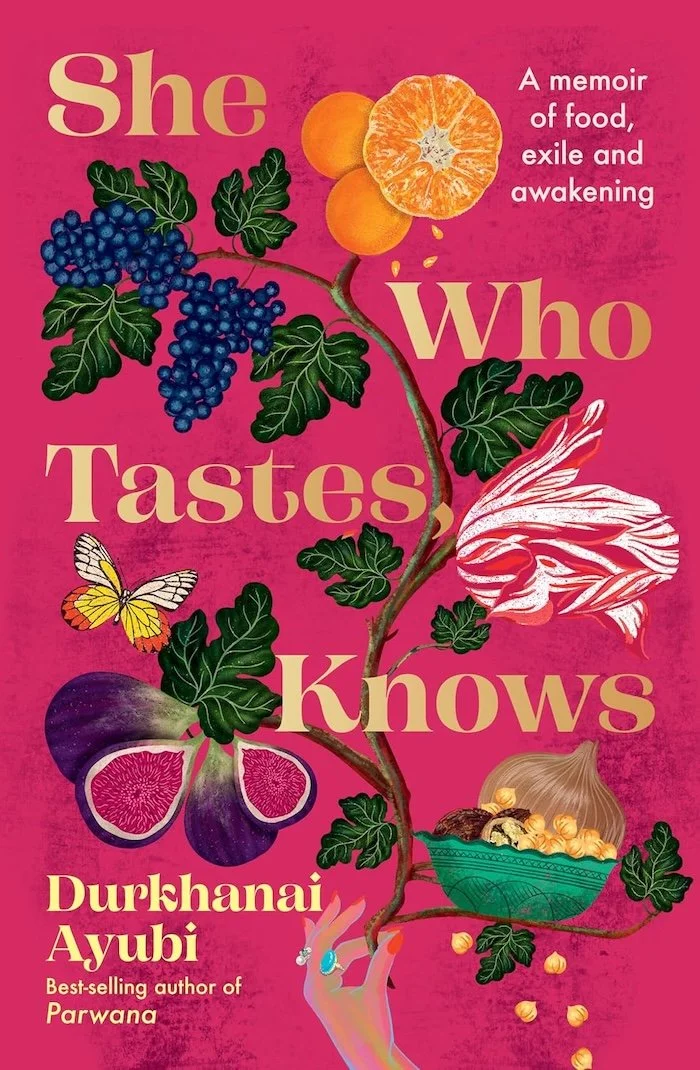
At first read, She Who Tastes, Knows: A memoir of food, exile and awakening (2026) is a book on how food connects people in the diaspora as they navigate identity and belonging. Food writing done well leaves you with a salivating mouth and a scribbled-down list of ingredients to pick up on your next grocery run. I had both while reading Durkhanai Ayubi’s vibrant memoir. However, as the story unfolds, Ayubi draws parallels between the hidden and bittersweet histories baked into the many ingredients and recipes she so exquisitely describes. Food becomes the entryway, not the final destination, into a nuanced dialogue around collective agency, loss of identity and what gives us the hope to push forward when no candle remains in sight.
Ayubi’s family fled Afghanistan during the Cold War in 1985, creating a new life in Australia as refugees. From the start, it is clear that Ayubi’s relationship to her homeland is complex: “All I had known about my roots was shaped by my sense of rootlessness.” Published six years after her celebrated book of Afghan recipes Parwana (2020), the memoir is a peek into the author’s own negotiation with herself as she is landlocked between the West’s collapsed narrative of Afghanistan and her own family’s quiet about their past. Throughout the memoir, she oscillates between unlearning the dominant narratives written by others and developing a relationship to her identity that is separate from her parents’ story. The book asks: how can storytelling happen if no one wants to talk about it? What are the dangers of others telling our story if we do not claim it ourselves?
The chapters are organised by different ingredients (mulberry, walnut, bitter orange) and the memories or histories attached to each one. Ayubi’s prose is deeply lyrical, describing the most mundane of culinary tasks with a poetic and almost childlike wonder. “I grabbed a handful of walnuts and threw them into the womb of the pot, one by one, like wishes.” Although some readers may find Ayubi’s floral descriptions verbose, I was delighted by her ability to amplify the rich flavours of Afghan cuisine through words. Reading Ayubi’s writing felt like lifting the lid from a pot and taking in one long deep breath, eager not to let any steam escape.
The book also outlines the rich agricultural heritage of her homeland, citing the findings of plant geneticists and botanists like Nikolai Vavilov, who described Afghanistan as “one of the most important primary world agricultural centres.” While at times I found myself craving the more textually enticing dishes and stories found on other pages, these sections point to the vast knowledge pools that are omitted in the West’s framing of Afghanistan.
With rich descriptions of stews cooked with plums and simmered eggplants bathed in onion and tomato, these recipes remind readers that sustenance and nourishment come easily to Afghans, who so generously provide to others. There is an uncomplicated irony of the abundance found in an Afghan feast and the lean narrative that plagues the ethnic group, holepunched by others into something resembling Swiss cheese. Through food, Ayubi unearths themes of power, colonisation and the suffocating point women find themselves in, cornered between the feigned concern of Western feminism and the imposed social roles demanded from within the culture. “The act of harvesting, preparing, cooking and feeding had long been undermined, weaponised and trivialised by every manifestation of patriarchal layers, from the Western world whose traditional feminism understood it as women’s oppression, and from within our own cultural systems, which historically demanded women to undertake these roles. But these practices were the crux of all sustenance and life.”
To belong to a diaspora means to exist in two realities. For Ayubi, this is apparent in the layout of her book: some days, to be of a diaspora means to sit with family and fold dough into neatly-shaped manta. On others, it means visiting cemeteries in your homeland to connect with those whose recipes you have memorised by heart. Through food, Ayubi is able to cross temporal, spatial and even spiritual dimensions.
“Amid black wattle, towering eucalupts, and hidden tubers and lilting grasses, through the generous scene of native thyme, I understand that my own ancestors and their imperishable wishes were sitting beside me and growing with me, within the arc of this parallel dreamscape all along.”
This liminal space is captured beautifully by the Afghan author, who attempts to describe the culture’s rich culinary repertoire without limiting the text solely to a “book about food.”
Mariam Vahradyan's work has been published or is forthcoming in SAVEUR, Pangyrus, Oh Reader, psyche, and The Razor, among others. She was a 2025 mentee in the International Armenian Literary Alliance Mentorship Program. Mariam is a Yerevan-born New Yorker, now living in Melbourne, whose idea of a good time is leafing through picture books. You can read more of her writing at mariamvahradyan.com/writing.