The Wax Child by Olga Raven, trans. By Martin Aitken
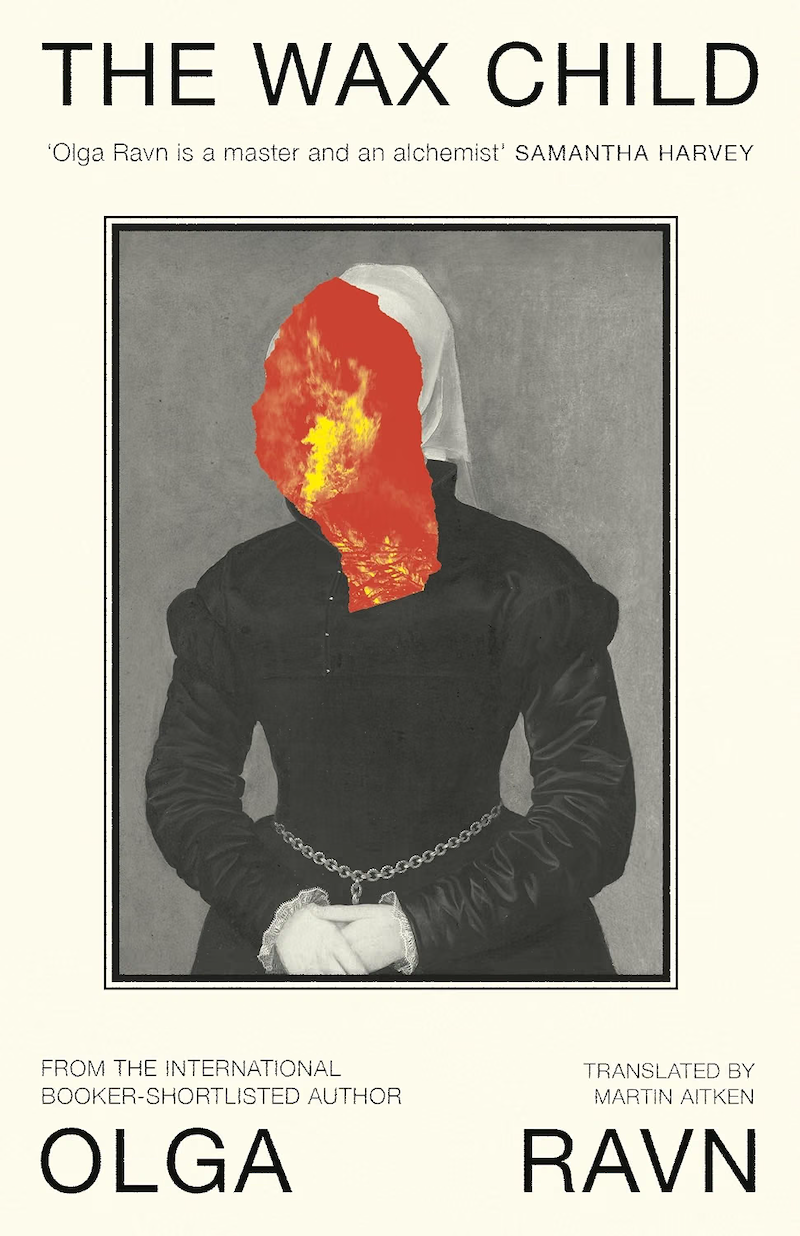
The Wax Child (2025) is both a tribute and a warning. Piecing together archival material, Olga Ravn’s novel recalls historical Danish witch trials, spotlighting why reason, justice and humanity are tenuous in the face of misinformation, fear, panic and misogyny. First published in Danish by Gyldendal in 2023, this English version, translated by Martin Aitken and published by Viking Penguin Random House, was longlisted for the International Booker Prize 2026.
In the novel, the wax child is a protective talismanic all-seeing oracle. Exemplifying Ravn’s talent for humanising objects, this silent witness, an infant carved out of wax, is our guide through a horrific history. While it’s vulnerable in a physical way, the wax child has powerful senses that receive information like sonic waves. It feels births, fear and love as well as collective panic, building. It speaks in first person, intimately embedding the reader into its sensory way of experiencing the world. “I see the king with the smell of the eye.” Its tone sits strangely between the innocence of a child and ancient wisdom.
The wax child is devoted to its mistress, Christenze, a strong, horse-riding noblewoman who is unmarried and doesn’t fit the genteel mould: “I think I love her with that part of me that is never illuminated.” We first meet them in Funen, Denmark. Christenze is one of several women taking turns to hold a medieval cloth birthing girdle of cloth. Inscribed with prayers these girdles were wrapped around a woman and thought to protect her during pregnancy and birth. In the novel, Anne Bille screams during childbirth and Christenze holds the girdle to absorb some of her friend’s pain. Anne is giving birth to another child she will sadly lose. Racked by grief, Anne blames Ousse, her maid, and Christenze. Rumours of witchcraft begin and Christenze is put on trial.
During the trial in Funen, the close and complicated relationship between Anne and Christenze is revealed. Christenze knows that a doctor told Anne why she can’t mother healthy children, yet Anne’s motivations for blaming Christenze are complex. We aren’t explicitly told whether or not Anne believes in witchcraft, however, as a woman who has had fifteen miscarriages and child deaths, Anne knows she’s in danger in a world where the woman is often the scapegoat. She needs to shift the blame. Although there are moments of solidarity, this is not the last time the women consider giving up friends to secure safety. Christenze flees to Aalborg and meets a group of women living on the fringes of society including Maren, her daughter Karen, Dorte, Apelone and Elizabeth. As the women find solace in each other, tension builds in the background and talk of sorceresses gains traction.
Ravn’s novel is based on real events that took place between 1596-1621, using the real names of condemned women and King Christian IV of Denmark and Norway, yet its narrative voice also carries darkness akin to a Brothers Grimm fairy tale. Spiders seep out of a baby’s mouth. A horse kicks, an eye bursts, flies buzz around a bandage. Ravn reinterpreted Nordic folklore from “blackbooks or grimoires”, interspersing spells between the short chapters. As a reader there is constant conflict between disapproving of the superstitions that lead to fear and brutal misogyny, while also being seduced by this parallel ‘magic’. Martin Aitken’s translation contributes by retaining a cadence that reads more like a poem or sermon than prose.
The misogyny, however, cannot be excused by fear or superstition. Throughout the novel, the persecution of women feels absolute. Anders and Manderup are king’s lieutenants who consult their demonology books before the trials:
“And they read: The woman is more easily tempted by Satan, for she is weaker than man in both body and soul… And they read: The woman is a wicked and imperfect animal. When a woman weeps she weaves snares, and labours to deceive a man. And they read: When a woman thinks alone, she thinks evil… And they read: In this dusk of the world, when sin is flourishing on every side and in every place, when charity is growing cold, the evil of witches and their iniquities superabound. And they read: Where there are many women, there are many witches.”
Every hit of “And they read” feels like another nail in a coffin of an inevitable injustice.
Through the wax child, the book asks – what if everything around us can feel? What if people’s experiences exist across time, infused into objects? Considering Anne’s painful labour, the wax child reflects, “I think that any person who travels to Nakkebølle today and who puts their ear to the dew immediately after it has fallen on the enclosing wall of the manor house grounds may still hear those cries.” In the end, our narrator vehemently condemns the murderers.
“Damned shall be your tongues, damned shall be your hands and feet, damned shall be your bodies and souls, until you are able to comprehend what by these deeds you have done unto your poor neighbours.”
A haunting read on persecution, The Wax Child also emphasises strength and openness. As a peculiar and poetically cryptic witness, the wax child itself has a worldview that doesn’t always make sense. At times, I felt a little lost. Wrapped up in mysticism. Sitting with that confusion feels like part of the point. Off the back of history and into the present, where misogyny still thrives, this short, gothic novel presents an ultimatum: humanely accept and respect others, whether or not one completely understands them, or risk a damned existence.
Caitlin Leishman is a Naarm-based freelance design journalist, communications specialist, research translator. A multi-faceted storyteller, she studied media and communications at the University of Melbourne. Caitlin’s career spans arts, design, science fields and collaborative projects such as life stories. She has regularly contributed to leading publications including est Living, Interiors Au and Habitus Living magazine. Caitlin is a voracious reader who can’t help but take note at every page turned, revelling in the gift that is seeing the world through another’s lens. Whether interviewing or reading, it is through unravelling the insights of others and interrogating her own perspectives that she fuels her own characterful body of work.