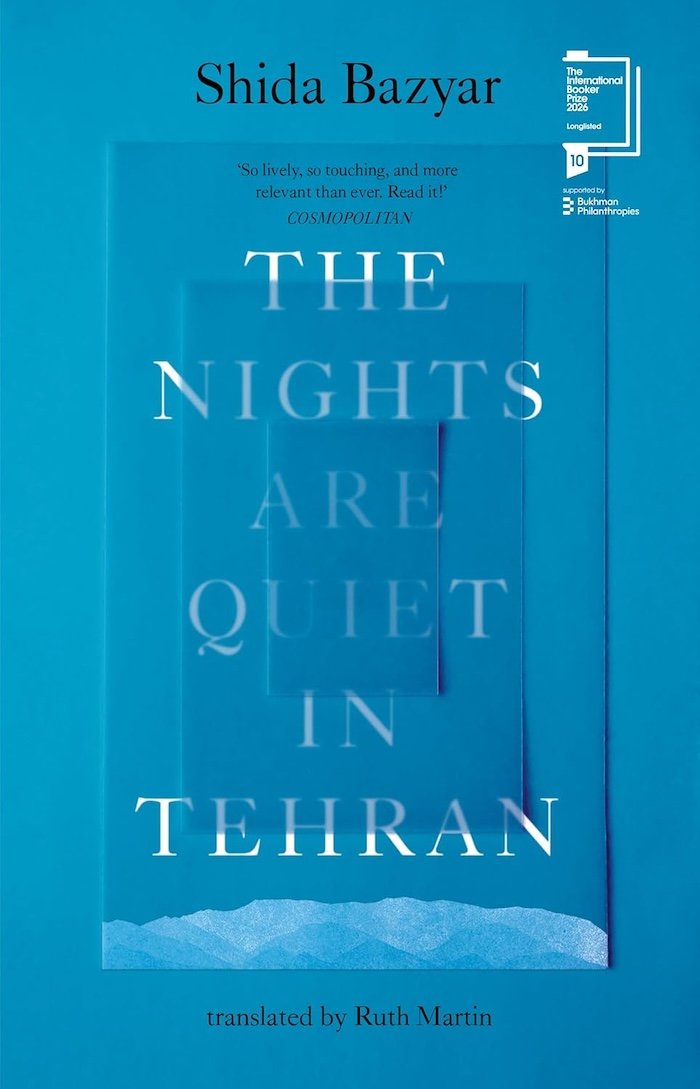
The Nights Are Quiet In Tehran by Shida Bazyar, trans. by Ruth Martin
“I think it’s weird; that laugh belongs in Tehran, with all the other treasures I’ve rediscovered here. And yet, it’s the laugh from Germany: how can it survive in this heat? How can she have imported her laugh, and how can it fit in so seamlessly?”
Taking its starting point from the 1979 Iranian revolution, The Nights Are Quiet In Tehran (Scribe, 2025) centres on one family and the far-reaching impact of their father’s involvement. Told in four parts over ten-yearly intervals, each section from the perspective of a different family member, we gain insights into the experiences of first- and second-generation refugees and the unyielding longing for home and belonging.
In 1979, Behzad, a young Iranian man, joins the resistance as political unrest grows in Tehran. Despite the intensity of his and fellow activists' political passion and talk of uprising, Behzad remains embedded in family life, living at home and observing domestic moments, such as the women preparing stuffed vine leaves and meals for the extended family. As he leaves home in the evening to meet with friends or take part in the protests, he senses his mother watching him closely.
“His new friends, whom our mothers listen to more than they listen to us, because believing in a god is so much easier than believing in new ideas.”
Tucked away in a private room with his friends, discussing the movement, he becomes aware of Nahid, a young woman who is also present. Despite Nahid being seemingly unaware of Nehzad, he feels a connection with her – one that we don’t learn much about until Nahid’s perspective in the second section of the book. As events unfold around Behzad, it becomes apparent that religious forces are overtaking the secular revolutionaries, and Ayatollah Khomeini emerges as the dominant power. The newly formed Revolutionary Guard begins arresting, torturing and executing dissenters, leaving Behzad and his companions increasingly fearful for their survival as they take bolder and bolder action.
The next section, set in 1989, is told from Nahid’s perspective. She and Behzad are now married and living in Germany as political exiles with their two young children. Again, observations of domesticity and the significant differences between Iranian and German ways of life play heavily on Nahid’s mind. While there is an Iranian community in Germany, Nahid can’t help but feel on the outside, noting that these families are not like their own. Despite this, she yearns for a sense of belonging.
“I have a longing for these people…for all the people who go to those celebrations, for their excessive make-up, for their lilting language, for their laughter and the searching look around the group that follows it.”
The dynamic between Behzad and Nahid grows increasingly bereft as the knowledge they cannot return home solidifies and Behzad listens obsessively for news about Iran on the radio. But Nahid also has a secret, one she is unsure yet how to feel about.
“You can’t explain to a one year old that his parents are known as communists and so they have to live under a false name in someone else’s apartment. Nor can you explain to a nine year old why you are packing your suitcases and leaving the country. You can’t even explain such a thing when the children are three and six.”
The third and fourth sections, set in 1999 and 2009 respectively, are told from Behzad and Nahid’s children’s perspective. In 1999, their daughter Laleh travels to Tehran for the first time with her mother and younger sister. Here, she is overwhelmed by the cultural formalities and physical closeness of extended family life, the noise of constant visitors, and the oppressive heat and pollution of the city. She tries hard to fit in, but it's constantly pointed out to her that she stands out. Her adolescence brings an intellectual awakening as well as a dawning realisation of the girlhood that’s slipping away from her.
“They sleep and snore, and it’s funny how meaningless sleeping bodies are for a waking body, how meaningless when they’re lying asleep beside you – I might as well be back in Germany then. I’d get just as little from them.”
Through her meeting with Nima, the son of a family friend who was executed, Laleh becomes aware of the student protests erupting in Tehran in their present day and the brutal repression of demonstrators by the authorities. Parts of her parents' past and those missing from the reunions in Tehran begin to fall into place.
In 2009, the narrative moves to Mo, Laleh’s brother, now a university student in Germany. Though initially detached from both his studies and his family, he begins to follow news of Iran’s emerging Green Movement and to reflect on his parents’ past. His participation in small-scale student protests points to a growing political awareness and sense of identity that he has previously chosen not to explore.
Both sections show how political asylum and being part of a diaspora continue to shape family generations in different ways, and how the complexities evolve and shift as the children of these families grapple with emerging knowledge and an understanding of their parents' lives. It also offers an astute exploration of the gendered differences and expectations placed on women and men, girls and boys, as they move through these experiences.
What stood out for me was the brilliant way each character’s voice is distinct, their internal worlds showcasing their unique perspectives and experiences with nuance. Ruth Martin’s translation undoubtedly plays a significant role in this, and I found myself feeling connected to each of the characters, particularly Laleh, as we learn more about their inner and outer worlds.
The Nights Are Quiet in Tehran is an emotional, engaging read. By zooming out from the details of Iran’s cultural history and political movements, and zooming in on one family’s plight, readers are offered an in-depth exposure to the humanity of these experiences that is so often lacking in news media content. With its recent longlisting for the International Booker Prize and resurgence of protests, this is a timely book that I urge all to pick up.
Elaine Chennatt is a writer, educator and psychology student currently residing in nipaluna. She has a special interest in bibliotherapy (how we use literature to make sense of our lives) and is endlessly curious about the creative philosophies of others. She lives with her husband and two bossy dachshunds on the not-so-sunny side of the river (IYKYK). Find her online at wordswithelaine.com.