A Wild Sheep Chase by Haruki Murakami
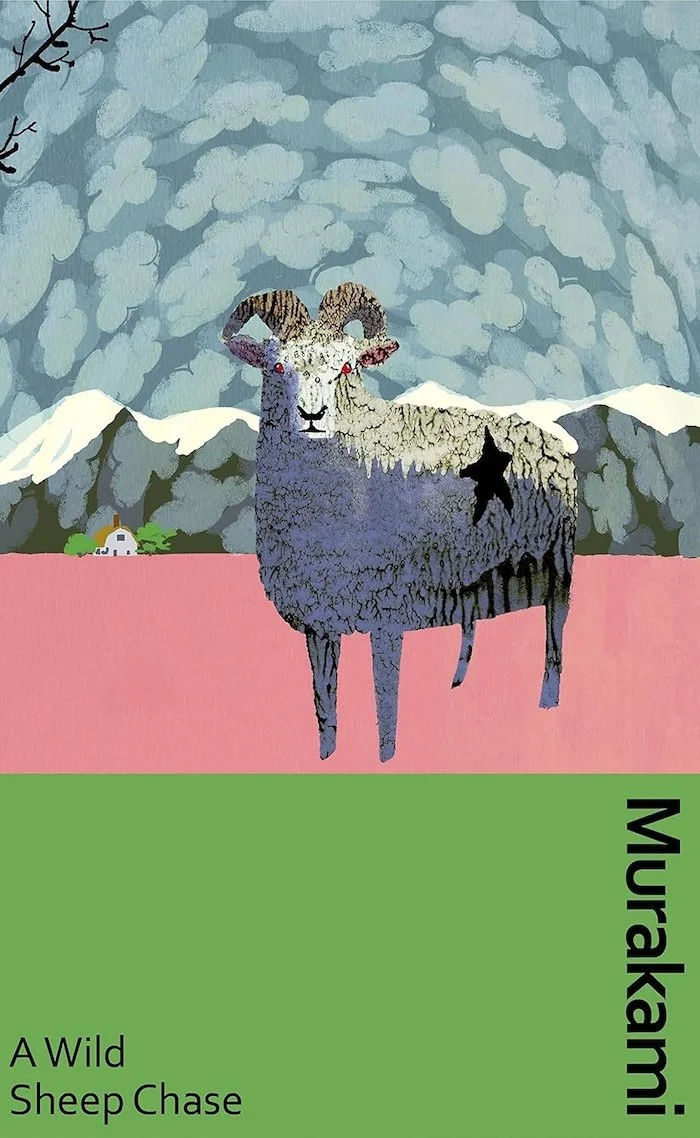
Haruki Murakami’s A Wild Sheep Chase (1982) – translated by Alfred Birnbaum in 1989 – is the third novel in his so-called “Trilogy of the Rat.” But don’t worry – it works perfectly well as a standalone, the same way a fever dream technically counts as sleep. As always, the Japanese author’s prose is deceptively simple, moving with the ease of a jazz pianist on autopilot. That is to say: cool, low-key, brilliant and occasionally making you feel like you’re the only one in the room not quite keeping the tempo.
We follow a nameless narrator whose humdrum Tokyo life is dragged sideways when he becomes entangled in a mysterious search for a mythical (and possibly divine) sheep with a star-shaped birthmark that has the power to possess people. Recently divorced, working in advertising, he nurses a hangover of disconnection that seeps into every page. He is so passive he makes wet paper look confrontational. At one point, he sums himself up with bleak precision:
“I was twenty-one at the time, about to turn twenty-two. No prospect of graduating soon, and yet no reason to quit school. Caught in the most curiously depressing circumstances. For months I'd been stuck, unable to take one step in any new direction. The world kept moving on; I alone was at a standstill. In the autumn, everything took on a desolate cast, the colours swiftly fading before my eyes. The sunlight, the smell of the grass, the faintest patter of rain, everything got on my nerves.”
That sense of arrested motion is Murakami’s true obsession. The chase is just an external force imposed on someone who has perfected inertia. Throughout, the characters don’t emote so much as observe themselves failing to emote, which becomes the emotional engine of the novel. Early on, the narrator muses:
“Body cells replace themselves every month. Even at this very moment. Most everything you know about me is nothing more than memories.”
Identity in this novel is unstable, provisional and largely accidental. Once you accept that, it becomes terrifyingly easy for something else – say, a metaphysical sheep – to move in. There’s also something deliciously sly in the way the author feeds you surrealism. With giant sheep cults, telepathic girlfriends with magical ears and Yakuza-grade secret societies led by dark men in suits, the bizarre is so thoroughly normalised that you stop questioning it and, in doing so, begin to notice the absurdity of the everyday.
The novel’s journey takes our narrator into the wilds of Hokkaido, where snowdrifts pile high and reality’s grip loosens. We meet increasingly strange figures – including a man who believes sheep are the apex of sentient evolution – and gradually realise the mystery isn’t really about the sheep. It’s about the silence left behind when something important disappears. The narrator’s dead friend is the novel’s emotional centre, despite not being present at all.
Technically, A Wild Sheep Chase is a detective novel but instead of hard-boiled grit and high-octane action, we get long, ambient conversations about mortality, loneliness and how to make the perfect sandwich. Murakami dismantles genre expectations, replacing resolution with rumination. When the novel pauses to consider the mundane, he articulates quiet despair.
“Whether you take the doughnut hole as a blank space or as an entity unto itself is purely a metaphysical question and does not affect the taste of the doughnut one bit.”
You can contemplate the void all you like; breakfast still tastes the same.
There’s plenty to say about Murakami’s themes – alienation, late-stage capitalism, the yawning void between individuals – but we also need to address the elephant (or sheep?) in the room: his women. If you’ve read the author before, you know the type: female characters who are less “person” and more “symbolic moon goddess who says something cryptic and vanishes.” The girlfriend here – mysterious, sexy and ear-forward – fits the pattern. She’s delightful on the page, but hard not to imagine whispering something hauntingly poetic about loneliness over a morning bagel.
This isn’t necessarily a flaw, depending on your taste. If you like your novels lightly seasoned with misogyny and people barely disguised as metaphors, you’ll cope. But it’s worth noting that the emotional stakes sometimes feel held together with sticky tape and ennui.
Ultimately, reading A Wild Sheep Chase is like following breadcrumbs left by someone who doesn’t believe in linear storytelling. It doesn’t give you what you want, it gives you what Murakami thinks you need: a meditation on identity wrapped in a shaggy story about herd animals and lost friendships. You may not fully understand what’s happening, but you’ll certainly feel something – melancholy, whimsy and the creeping suspicion that you, too, are one missed call away from joining a sheep cult.
Kit Edy is a long term transformative and original works writer, currently studying English Lit and International Relations, residing in metropolitan Sydney with an unhealthy relationship to caffeine and wool knits. Read more here.