It’s been a while since I put together a list like this; life (and toppling TBR piles) have dutifully gotten in the way. But something about 2026 and all the new titles I’m already seeing and anticipating got me inspired.
Here’s a brief look at what’s caught my eye so far.
Fiction
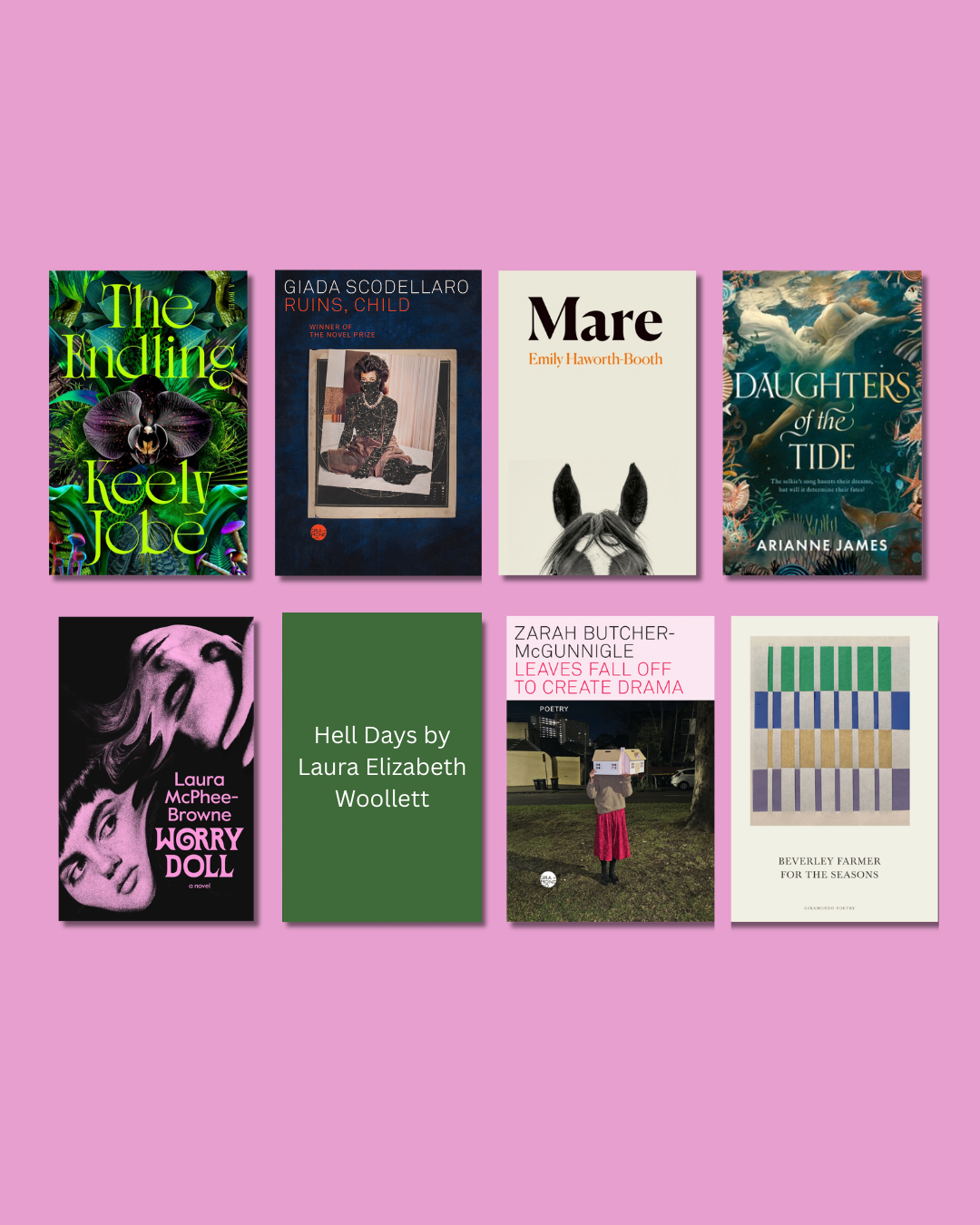
The Endling by Keely Jobe
Scribe, March 2026
(Spoiler: I’ve already, excitingly, received an advanced copy of this one!). As a Lutruwita dweller myself, I of course get excited for any releases from writers on the island and Keeley Jobe’s debut novel sounds superb.
Jobe explores what happens when “a feminist utopia crumbles with one impossible birth”. In a community inhabited exclusively by women, living on an isolated mountain, things take a turn when the women begin falling pregnant. When one of those women, Mila, gives birth to a boy, the community faces an impossible challenge. Described as “vividly expressed, wildly funny, and wholly original”, The Endling explores “what happens when the borders we construct between species, between sexes, between self and world prove more porous than we imagine.”
Ruins, Child by Giada Scodellaro
Giramondo, March 2026
I fell head over heels in awe of the previous two winners of The Novel Prize, so I cannot wait to get my hands on the 2024 winner, officially published in Australia this March.
Described as “remarkable for its irresistible sweep, wit, and prickly splintered truth”, Ruins, Child is set *maybe* in the future as six women share a space in a dilapidated apartment. With a blurb that advises the book is “kaleidoscopic, pointedly disorienting in its looseness, and powered along by snatches of speech”, Ruins, Child seems to following suite of previous winners by offering readers something that truly sidesteps traditional ideas of ‘how’ a novel should be. If, like me, you read and loved It Lasts Forever and Then It’s Over by Anne de Marcken (the previous winner), it sounds like we’re in for a real treat with Scodellaro’s work.
Mare by Emily Haworth-Booth
Granta, March 2026
I’m a through and through horse-girl (at least, I was growing up) so when a book about a woman coping with various forms of grief through the care of a horse got on my radar, it went straight to the top of my ‘must-read’ list.
Haworth-Booth’s award-winning debut, follows a woman undertaking the part-time care of a mare after her dog dies and she learns she is unable to have children. What begins as a distraction gradually turns into obsession and she must “confront what it means to love a being who did not come from her body and who does not belong to her”.Sold for this reader!
Daughters of the Tide by Arianne James
HarperCollins, May 2026
Full disclosure, I’m not the biggest historical fiction fan, but I do love a bit of folklore storytelling, and selkies are one of my favourites (plus Arianne is another debut Tasmanian writer for this year)!
Exploring “memory and self, the resilience of women and a dangerous longing for the sea”, Daughters of the Tide centres on the Findlay family and their secrets. The family history is littered with tragedies and rumours of madness, and Isla Findlay is all too aware of this. When her estranged aunt returns to their coastal Tasmanian home, Isla’s own past memories begin to stir, with disturbing dreams of seals and haunting songs. Blurring what’s real and imagined, Daughters of the Tide is “a tale of madness and miracles, secrets and sins, myth and reality, and the tenacity and resilience of women in the face of impossible choices”.
Worry Doll by Laura McPhee-Browne
Scribe, June 2026
There’s little been said or released about this one yet, but what has been shared has got a lot of readers (myself included) all fired up. Described as “obsessive, all-consuming, and impossible to look away from”, Worry Doll follows the meeting of two women – Heloise and Lacey – on a train on one ordinary day.
The novel centres on what follows, “a passionate affair that will consume them both in mismatched and maddening ways” in a close examination of desire, memory and the delusion of love. Can’t wait!
Non-Fiction
Hell Days by Laura Elizabeth Woollett
Scribe, September 2026
I’m increasingly interested in first person perspectives on women’s health experiences, as my work and study lives continue to converge in this space. I was immediately interested when I saw that Woollett would be publishing her first non-fiction book about her experiences with premenstrual dysphoric disorder (PMDD).
You don’t have to be well-read or research-focused to know that women’s health is under-researched, under funded, and under cared about. Alongside her personal experiences, Woollett brings together “case studies, interviews, extensive medical research, forays into history, true crime, and algorithmic rabbit-holes” and insights from scientists and clinicians to explore this complex condition. Hell Days is described as a “testament to the precarity and dignity of life as a periodically suicidal person in an often-brutal world” and if Woollett’s writing here is anything akin to her non-fiction writing I’ve been reading elsewhere online, this is set to be a thoughtful, searing and important read.
Poetry
Leaves Fall Off to Create Drama by Zarah Butcher-McGunnigle
Giramondo, April 2026
I’m endlessly interested in any works that explore our emotional and mental experiences, and Leaves Fall Off to Create Drama looks to be an astute exploration of just that.
Butcher-McGunnigle’s collection invites readers to “consider the relationships between internalised beliefs and the development of illness, drawing on psychology texts and the language of self-help, and the exploration of character traits and dramatic tropes”. Exploring the relationship between “unexamined subconscious thinking and physical and mental health”, these prose poems resist “singular, fixed meanings” to invite readers to consider their own experiences.
For the Seasons: Haikus by Beverley Farmer
Giramondo, February 2026
Full disclosure, I did not love Farmer’s slim novel Alone when I discovered and read it a couple of years back, but I’m willing to put that aside as a dedicated lover of the haiku form.
These poems were compiled over twenty-five years ago and discovered in 2018, following Farmer’s death, by critic and scholar Lyn Jacobs – who also provides the introduction to the collection. Published for the first time, the collection is sectioned by seasons, centring on Farmer’s “immersion in the coastal landscape around Point Lonsdale on the Bellarine Peninsula in southern Victoria”. Described as “modest, self-effacing, and yet revelatory in its intensity”, this sounds like the perfect read to spend time with as the seasons begin to change from summer to autumn.
Elaine Chennatt is a writer, educator and psychology student currently residing in nipaluna. She has a special interest in bibliotherapy (how we use literature to make sense of our lives) and is endlessly curious about the creative philosophies of others. She lives with her husband and two bossy dachshunds on the not-so-sunny side of the river (IYKYK). Find her online at wordswithelaine.com.