In The Desert by Barbara Byar
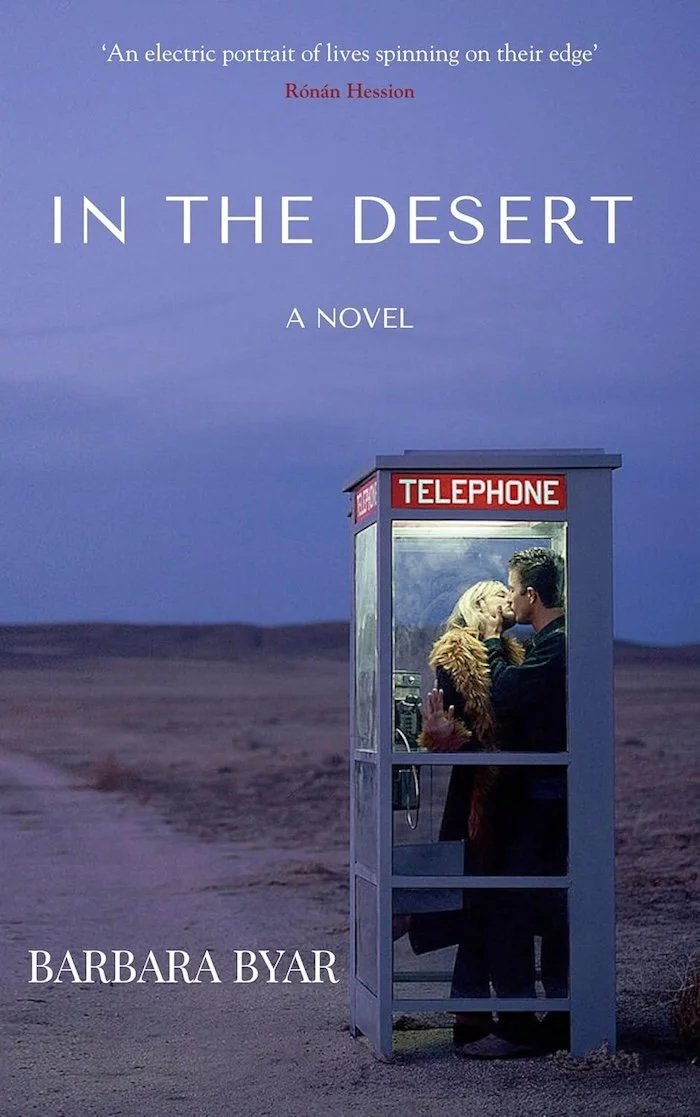
Five childhood friends come of age in a small desert town. Surrounded by a yearning to leave and the pressure to stay, each makes decisions over the course of twenty-four hours that spark a series of catastrophes across time and space, leading to a phone booth, in the middle of nowhere, ringing…
I’ve followed Barbara Byar’s flash fiction writing for many years. I enjoyed her flash collection Some Days Are Better Than Ours (2019), billed as a collection of tragedies. The transition from flash writing to the novel has always intrigued me and I’ve followed the transition of many of my writing contemporaries from short to long form. When I heard about Byar’s novel In The Desert (2026, Cowboy Jamboree Press), I immediately requested a review copy. How would Byar’s sharp, focused writing translate into a novel?
Byar’s style is apparent in the opening sequence of the book, with sharp, truncated sentences delivered in a single breathless rush. She continues that through the entire book. I felt as though I’d ridden a rollercoaster thirty-seven times in a row when I got to the end of it; my mind was left reeling. The pace here is absolutely relentless. There are echoes of Byar’s having cut her writing teeth on the short form in the way each chapter reads almost like a flash fiction piece of its own, and she leans into that with each piece connecting to another – but not necessarily the one before or after it. The darting back and forth in time lends to the sense of feeling off-kilter as one reads but it’s hard to imagine a story like this being told in any other way. It’s disorienting to read these short scenes in non-linear fashion, but that sense of being spun back and forth feels essential to the story itself, and adds a level of something akin to immersion. It's difficult to talk about the plot of the book without giving too much away – it felt essential to the reading experience to not have an idea about how the book unfolds. Suffice to say it grabs you, spins you around and spits you out, then echoes in your mind long after the last sentence.
In the Desert is a magical realism-speculative fiction-sci-fi mashup, difficult to explain in a single genre. The world itself is an American near-future adjacent to this one, in which climate breakdown and its consequences are evident: the titular desert is expanding while things like water, food and medical care are rationed and increasingly difficult to come by. For the characters relying on these things for their lives and livelihoods, the lack of access to them is critical to the decisions they make and the spinning wheel of consequences those decisions lead to. The world itself and elements of it act as a silent character in the novel. The heat, the dust, the faded aspects of the small desert town around which much of the action is based enhance the sense of degradation and oppression that the characters face in their lives there, the forces that hold them in place while also driving their ambition to leave. The stars in the night sky are a perfect segue into both the quantum mechanics that form one key element of the story, alongside the more mythological elements, and serves as a way to tie together science and spirituality in a way that lets them coexist both as concepts and in the context of a relationship.
The setting might be somewhat fantastic but the characters are real people with very real problems. If good storytelling means making the characters suffer, Byar does this in spades. She doesn’t shy away from showing humanity at its most complicated and often unsavoury. Her cast are subjected to almost every variety of trauma possible, and the result will be a stack of trigger warnings at the front of the book. This is not a book for the faint of heart. But it had to be that intense to serve those characters, to put them in the position to make the choices they do, in the face of consequences known and unknown.
“He floors it; he’s about ten years late, but better than never. He'd left cause he had to. Would have shriveled like shed snakeskin. Blown away. It was a mistake, he knows that now, but there’s no undoing, only done.”
Choices and consequences are a major theme in the book. Each character is forced to confront what they’ve done, and how they’ve responded to what’s been done to them. Byar does a magnificent job driving the development of her characters through the decisions they make, the results of those decisions and how they reckon with that loop of choice and consequence. In the revelations of actions and results, often told out of order, the reader is given many insights into the complexity of the human psyche. These questions are often asked: is one person’s horrendous action softened by what’s been done to them in the past? Are the worst actions of people ever excusable? And when the worst happens to someone, do they ever deserve it?
“He’s been warned all his life about the carnival but maybe, just maybe, it will be worth the risk. Maybe there’s something there to save his mom, and Estella to find some peace.”
The other key theme in the book is a question: how far will we go to protect the ones we love? Each of the characters is protecting or being protected by another, often simultaneously, and they don’t always succeed. Choice and consequence rise into this theme as well – what is said and not said by each character, and the secrets they keep from each other. Decisions are made without someone having the full context; often, characters try to make decisions on behalf of others thinking they’re doing the ‘right’ thing, or attempting to atone for their own shortcomings by stopping someone from making their own choices and dealing with the fallout of them. There’s often a selfish motivation behind these actions as people try to assuage their guilt or sense of betrayal. And sometimes even selfless motivation has devastating results. But in the end, it’s love that drives this book, even in its darkest moments.
With echoes of David Lynch and a sprinkling of Tarantino squashed into a bone-rattling fever dream, In the Desert is undoubtedly brilliant writing. Whether you think it’s incredible or disturbing, it will sit with you long after Byar has gathered the handfuls of story thread from across the pages and wrestled them into a satisfyingly knotted ending. You will be desperate for someone else to have read it too, so you can spend hours debating, discussing and dissecting it. This is a startling and accomplished debut novel that left me wondering how on earth Byar could possibly have managed to write it and excited to see what she tries next.
Amanda McLeod is a creative based in Canberra, Australia. She’s the author of two books, Animal Behaviour and Heartbreak Autopsy, and has had many pieces published both in print and online. Her recent works explore nature, ecology and connection, and some can be found in EcoTheo Review and Wild Roof Journal. A self-professed tree nerd, you can usually find her outside by the nearest river. If she’s not there, try Twitter and Instagram (both @AmandaMWrites) or her website AmandaMcLeodWrites.com.