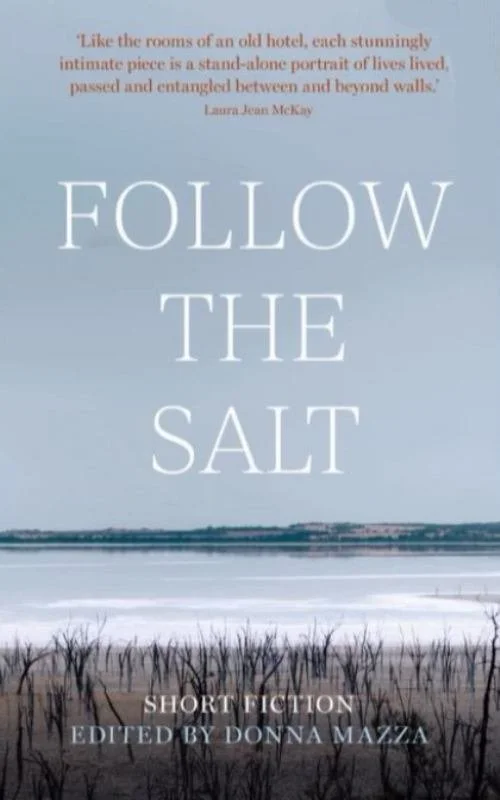
Follow the Salt ed. by Donna Mazza
“Someone told her once that all whales eventually reach an age where they can’t bring their bodies to surface anymore to catch a breath and they drown, giant bodies sinking to the ocean bed. But she knew that here that wasn’t true – these whales hadn’t drowned. Something about this grave, this shed of old machinery and drums, hidden from the sky, so far from the sea, did not seem right.”
The latest collection from Western Australian publisher Night Parrot Press takes a different approach to their previous (excellent) flash fiction anthologies, and the result is a powerful read. In mid-November 2024, eleven writers travelled to the Wheatbelt in WA to stay in the Grande Olde Dumbleyung Inn. Together, they shared an experience of what life is like in the long-forgotten farming towns of this part of the world, and took this as their starting point for creative experimentation.
In her introduction to the collection, editor Donna Mazza advises that throughout the collection, “the bizarre and surreal intrude into the normal world, perhaps because that is how we felt going into that place.”
Bizarre and surreal is accurate; many of the stories were far more speculative than I anticipated. From eerie farm hauntings to whale storms, salt-hungry nanobots to otherworldly (and very worldly) threats, all the stories take the hotel as their starting point and reach outwards from there.
‘Breaching’ by Tiffany Hastie was a stand-out favourite for me, with the simple but expertly crafted idea that in this dry, land-locked place, whales would suddenly appear in the streets, as though they had fallen from the sky in a storm. For two journalists travelling through the town, the experience is a shock, but for the locals, it’s business as usual. As the journalists attempt to unpack the situation further, the story offers a haunting reminder of the ways humans have exploited land and waterways for their own purposes, disregarding and disrupting the natural order of things.
“Greta was woken at dawn. Lee’s shouts punctuating the corellas squawking in the pale gums near the truck bay. He pulled up her window from outside and she shuffled out, hair a mess. The rain had stopped but in front of them, almost higher than the veranda, a giant curved shape, like some modern art installation. But it was thick skin, a high curved back, slick grey body.”
As well as missed connections, lost loves and grief, environmental destruction, climate change, and over-farming are all strong themes throughout. References to Lake Dumbleyung and the sacred Indigenous spaces around the lake are woven into most stories. Again, this emphasises the destruction of land and waterways, once so well cared for by First Nations peoples in these places.
‘Remnants’ by Aksel Dadswell (another favourite) imagines an otherworldly presence coming to claim the land, destroying any human in its wake, as a local bird watches on. ‘The Salinites’ by Amber Black envisions a future where high-tech farming has gone awry, creating a population in which nanobots that absorb salt have infiltrated the bloodstream of the locals. ‘Smokescreen’ by Jodie How focuses on farmers' reluctance to adopt new practices despite the risks they know a dry future will bring.
“Where once, not so long ago, the lush sounds of nature marked time, now there was only the hard crunch of his soles across the crust. When he stopped, a funereal silence gripped him. He knelt and pushed a palm against the jagged earth, tainted grey with run-off from the nearby crops. Nearby. Crops. From his farm.”
There’s a potential risk of repetition when a place remains constant in a collection of this format, but this is far from the case in Follow the Salt. Instead, the hotel and its surroundings become an anchor. With each story, we learn a little more about the history, challenges and people of the place.
This is a really compelling collection that I found myself reaching for throughout the day, eager to read the next instalment and see where else the experience might have taken the writers who contributed and what other secrets the land might have shared with them.
Elaine Chennatt is a writer, educator and psychology student currently residing in nipaluna. She has a special interest in bibliotherapy (how we use literature to make sense of our lives) and is endlessly curious about the creative philosophies of others. She lives with her husband and two bossy dachshunds on the not-so-sunny side of the river (IYKYK). Find her online at wordswithelaine.com.